How Times Have Changed
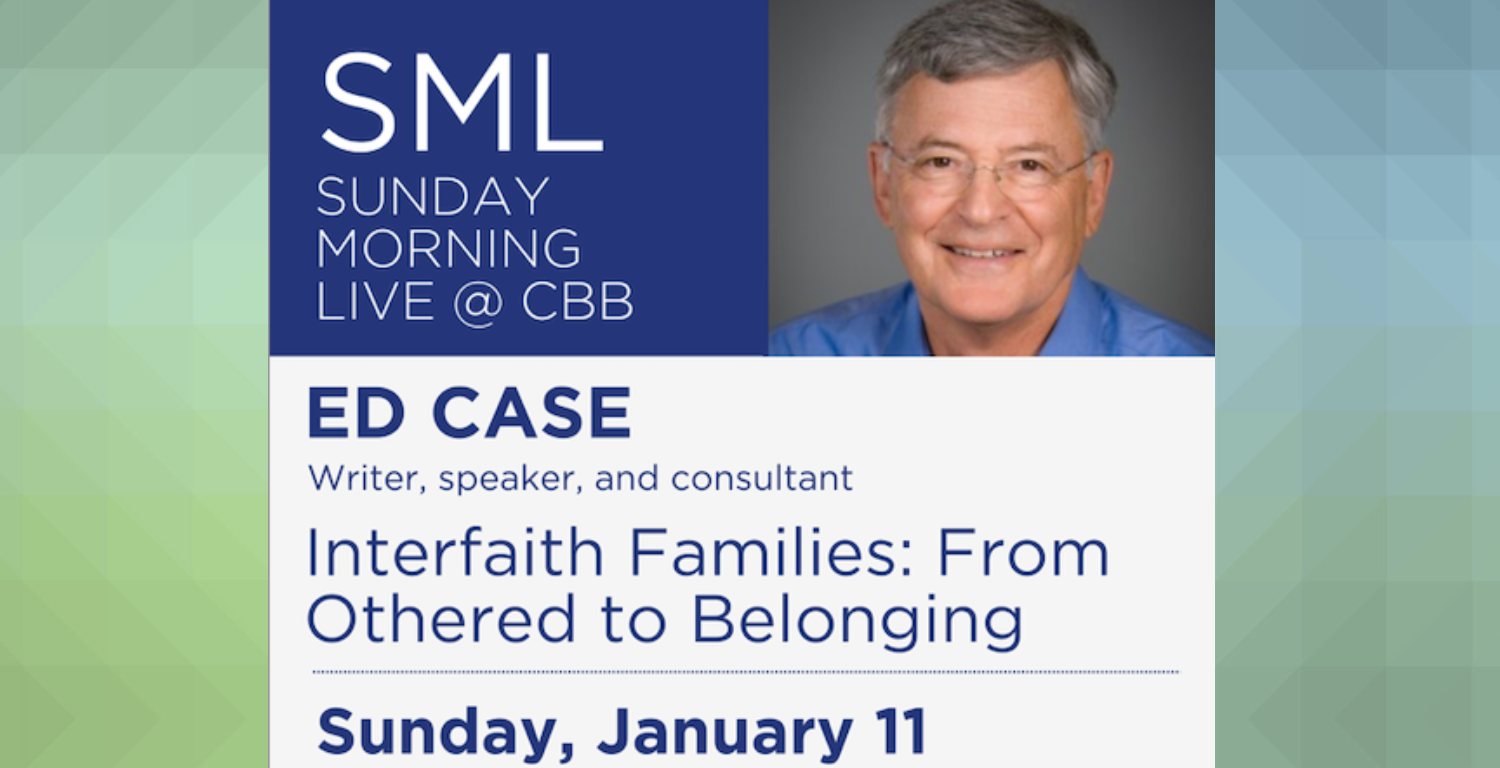
On January 11 I spoke at Congregation B’nai B’rith in Santa Barbara CA for the second time – the first was in December 2005. I took the opportunity to reflect on what’s changed about interfaith family inclusion over the past twenty years – and what work remains to be done. You can see the presentation on this video; the powerpoint slides are visible, and I’d be glad to share them.
One thing that’s changed is the fading away of the explicit hostility to interfaith marriage that was prevalent among Jewish leaders in 2005. In 2001, Sylvia Barack Fishman had done a study which concluded that interfaith families who say they are raising their children as Jews “incorporate Christian holiday festivities” into their lives such that Jewish identity is not transmitted to their children, even though they say that these festivities have no religious significance to them. I described this back then as “simply ridiculous,” based on surveys and an essay contest conducted by InterfaithFamily (now 18Doors).
After Fishman turned the study into a 2004 book, Double or Nothing?: Jewish Families and Mixed Marriage, I expressed fear that Jewish leaders would say that the “latest research” showed that “interfaith couples who were trying to raise their children as Jews shouldn’t bother because they won’t succeed,” and that “the Jewish community shouldn’t waste resources on outreach to mixed-married families, since the vast majority are not ‘really’ raising their children as Jews.”
I expressed hope that responsible Jewish leaders would insist on more conclusive social science research “before writing off the new families of the half of all young Jews who are intermarrying, thereby alienating their Jewish parents and relatives as well.”
I’m feeling vindicated all these years later. The Cohen Center at Brandeis just announced a new study which I think provides that more conclusive social science research. It notes:
Other work [citing Fishman’s 2004 book] has suggested that Jewish families who celebrate Christian holidays, or use Christian holiday decorations such as Christmas trees, struggle to instill Jewish identity in their children – even if these families do not treat these holiday activities as religious.
However, the results presented here suggest that at least some of the families who celebrate Christmas expose their children to more Jewish experiences than other families that had no Christian experiences at all…. [E]xposure to some non-Jewish religious-cultural experiences during childhood does not necessarily preclude high levels of involvement in Jewish life. (page 22)
The study (you can read a more detailed review here) even finds that children who celebrated Christmas and Easter (presumably in interfaith families) but were otherwise Jewishly involved “were more likely to have had a bar or bat mitzvah, to have attended Jewish supplementary school, and to have attended Jewish camp” than children who celebrated Hanukkah and Passover and had no other Jewish or Christian experiences (presumably these are inmarried families). (page 21)
Think of it – research confirms that some interfaith families are more Jewishly engaged than some inmarried families! Twenty years ago, we used to say that interfaith marriage didn’t determine the Jewish engagement of a family, the family’s choices did; we used to say that the Jewish partners in interfaith families couldn’t take their Jewish engagement for granted, they had to work harder at it. The new study seems to confirm that we were right.
Coincidentally, with all this looking back, in early January JTA published an article about the long-ago (1926) interfaith marriage of songwriter Irving Berlin that described issues around interfaith marriage as long-standing and continuing.
Even back then there were enlightened views. The editor of a Jewish newspaper actually said, “Mazel tov, Mr. and Mrs. Berlin!” Irving Berlin said, “It never struck me that I would be sacrificing a parcel of my Jewishness by marrying Ellin, and I suppose Ellin felt the same way about her religion. I am proud of my Jewishness, but you will never convince me that intermarriage is anti-anything.”
Jewish Camp
“For multifaith families, Jewish camp doesn’t have to feel awkward anymore” is a very promising report about the Foundation for Jewish Camp partnering with 18Doors to increase participation of children from interfaith families in overnight camp.
 Noting that only about 22% of overnight campers come from interfaith families, 18Doors’ Adam Pollack says “That gap [with the high rate of interfaith marriage] tells us camps are not yet representative of the Jewish population today. We’re trying to find ways to make Jewish overnight camp accessible and appealing to families who already consider themselves part of the Jewish community but may not feel certain that camp is for them…. We know how transformative camp can be. We want all Jewish kids – including those from multi-heritage families – to have access to that experience.”
Conservative News
The main point of my Santa Barbara talk was that we still need to adapt attitudes and policies so as to help interfaith families and partners from different faith backgrounds feel that they belong in Jewish communities. The tension between including interfaith families and maintaining traditional understandings of Judaism as a boundaried system just for Jews continues to manifest in the ongoing turmoil in the Conservative movement.
As reported last month, the movement’s Joint Working Group issued a report with a goal to “engage intermarried couples more fully” but retaining the movement’s ban on their rabbis officiating at weddings of interfaith couples.
 The report says that the Working Group “commissioned thirteen informal position papers from historians, social scientists, and rabbis.” I was invited to make a submission to the Working Group, and with their permission it is now public, on our new resource that chronicles related developments in the movement since 2014.
There was a lot of discussion about the report this month. 18Doors’ Adam Pollack offered a very interesting and positive response. I hope he’s right that “By ‘acknowledging and healing hurt,’ the movement has set a new course toward belonging” for interfaith couples. I hope 18Doors can help the movement in implementing the report’s recommendations. But I also hope the movement will address and change its position on officiation as I believe it must to truly be a place of belonging for interfaith families.
Conservative Rabbi Ari Yehuda Saks explained why, despite the movement easing its stance on interfaith marriage, he is quitting the Rabbinical Assembly:
I could not in good conscience remain a member while being prohibited from co-officiating intermarriages — ceremonies that I, from deep study and pastoral experience, have come to believe are not only possible within the halakhic, or Jewish legal, tradition, but are also vital for the future of American Judaism.
On the other end of the spectrum, Conservative Rabbi Amy Walk defended the movement’s approach. While pleased that the movement apologized for its past rejections of interfaith families, she says criticism of not allowing Conservative rabbis to officiate is short-sighted, binary, sloppy thinking.
Rabbi Walk said these critics “abandon ideas about commandment and covenant.” But the movement adapted halacha to allow women to be rabbis, and to allow wedding officiation for gay and lesbian couples – was that abandonment of commandment? And if the rationale for not officiating is Judaism’s traditional view that interfaith marriage is wrong, doesn’t maintaining the ban on officiating undermine the report’s efforts not to disapprove of and reject interfaith couples?
Even further out on the spectrum, Conservative Rabbi Daniel Gordis in a substack post says he was “stunned” at the Conservative movement’s apology; he “would argue that the policy against intermarriage has been a central pillar of maintaining Judaism’s tribal nature.” Gordis recognizes that defending the tribal dimension of Jewish life “has becoming increasingly difficult in a world in which young people, Jews definitely among them, find tribal sentiments either foreign, or outright objectionable.”
Gordis’ attitude is a prime example of what still needs to change. Thinking of Judaism as a tribe of Jews, instead of as a community of Jewishly-engaged people, is a huge obstacle to engaging interfaith families.
And finally, from the Orthodox perspective, Rabbi Emanuel Feldman says that by “’welcoming people as they are,’ the Conservative movement is declaring that they accept intermarriage.”
Also in the News
- On January 27 the Jewish Grandparents Network hosted a virtual Grandparents Learning Fest that included a session led by Rabbi Samuel Klein, the director of Jewish engagement at the Jewish Federation of Greater Seattle, titled “Doing Jewish, Feeling Jewish, Being Jewish: Grandparents as Guides in Mixed-Heritage and Multifaith Families.” The session was to “share practical insights and provide inspiration for grandparents to nurture Jewish identity in diverse families.”
- “Talking to Children About Jewish Identity in an Interfaith Family” is a new offering on the Reform Judaism website.
- A lovely story in The Free Press, “I’m Christian. My Wife Is Jewish. Our Marriage Is an Act of Faith,” by a Catholic editor who says his marriage to a Jewish woman brought him closer to God. I loved this part:
One day when our children were small, I was playing with them in our living room. Our 3-year-old son was keen to put things in their proper categories. Attempting a slightly more advanced version of the ‘square pegs in square holes’ game, he observed, ‘I’m Jewish and Rachel is Jewish and Mommy is Jewish.’ His brow furrowed, and he looked at me with a compassion that still causes my heart to ache. ‘Don’t worry, Daddy; Toby is an Episcopalian.’ Toby was our dog at the time.
* * * * *
Congregation B’nai B’rith in Santa Barbara is a warm and thriving synagogue with a very popular monthly Sunday morning breakfast and speaker series. The audience of about 120 was very engaged, with questions during and after the presentation. Rabbi Daniel Brenner told me they had great feedback, with one person inspired to restart their interfaith family conversation series. I’m very interested in speaking elsewhere.
One last point about the Cohen Center’s new study shows that interventions can increase feelings of belonging: it found that for those who were Jewishly involved but celebrated Christmas and Easter, the percent that reported feeling “very much” part of a worldwide Jewish community after participating in a Birthright Israel trip increased from 27% to 37%. (page 19)
Finally, thank you to all who made a year-end contribution to the Center. Support is always welcomed, at www.cfrij.com/donate.
Leave a Reply