A Three-Generation Yes or a Three-Generation No? Guest Post by Rabbi Wes Gardenswartz

|

The Center is honored to publish with permission a statement by Rabbi Wes Gardenswartz, Senior Rabbi, Temple Emanuel, Newton MA, delivered at the United Synagogue of Conservative Judaism Biennial, December 9, 2019 – 11 Kislev 5780.

Background: I was asked by the United Synagogue of Conservative Judaism to participate in a panel to discuss interfaith marriage. The views in this statement are mine alone. I do not purport to speak for our synagogue, our board, or my colleagues.  This is from me, not from Temple Emanuel.  These are words from my heart, and I recognize  and totally respect that reasonable people can reasonably disagree.  We are deeply blessed to inhabit a religious tradition, and a thriving community, that can handle difference, diversity, and complexity with love and with mutual respect.

Rachel and Christopher walk into my study.  Rachel grew up at Temple Emanuel, a Conservative shul in Newton, MA.  She went to our religious school. Had her Bat Mitzvah here. Remained active in USY.  She always assumed she would marry a Jew.  She only dated Jews. She just didn’t have any mazal in finding a partner.  In fact, often when she told the Jewish men she dated that Judaism was important to her, all too often what she got back in return was disdain.  They would share their bad religious school story.  They could not understand how any adult could take this stuff seriously.

One day, when not even looking, not on an app, not on a blind date, just in the ordinary course of life, she meets Christopher.  Christopher is not Jewish, but he does not see himself as connected to any religious tradition.  He is thoroughly unchurched.

Rachel and Christopher become friends, and then more than friends.  They have a connection that is organic and deep. They fall in love.  While Christopher is not Jewish, he deeply respects Rachel’s Jewishness, and he wants to support her.  They would like to get married, and now Rachel, who has known me for 23 years, and her fiancé come to ask me to officiate at their wedding.  They are both 33 years old.

It would be great if Christopher would convert.  Conversion would clearly be our preferred option. We would move heaven and earth to encourage him to convert if he were open to it.  But here is what he says.

He says: I love Rachel for who she is.  I want to be loved for who I am.  Maybe in time I might choose to convert, but I want to do it for the right reasons, and in the right time.  The right reason is that this is something that I want to do, that I am drawn to.   The right time is when I feel ready.  I don’t want to do it to make her parents happy, or to make clergy happy, or as a condition  to a wedding.  I am happy if our children are raised Jewish.  I would be partners with Rachel in their getting a Jewish education. But I am not ready to convert to Judaism unless I feel it is something I want to do because it feels right to me.

I think Christopher’s position is perfectly reasonable.  I believe officiating at their interfaith wedding is the right thing to do at the Jewish level and at the human level.  Let’s take them in turn.

Why is it the right thing to do at the Jewish level?  Because whatever response we offer Rachel and Christopher is a three-generation response. Don’t miss this point. If you remember nothing else of what I said, remember this:  No is a three-generation no.  Yes is a three-generation yes.

If we say no, what will happen? Does anyone seriously think that Rachel and Christopher will not get married if I say no?  Of course not. There is a 100 % chance of them getting married.  Perhaps they will get married by a justice of the peace; or by a friend or sibling deputized as clergy for the day; secular contexts devoid of Yiddishkeit.   Secular contexts which will not lead into a future of Jewish engagement, especially since their rabbi said no.

The best case, for their Jewish future, is that they will be married by the fabulous Reform rabbi, of the thriving Reform synagogue, the next town over.  That is good for them. Good for their Jewish future. Good for the Reform synagogue.  Bad for us.  Rachel and Christopher will join that Reform synagogue.  When their children are born, they will be educated at that Reform synagogue.  And then it is inevitable, as the sun rises in the east and sets in the west, that at some point Rachel’s parents will send a note to our executive director saying:  We are joining the Reform synagogue where our children and grandchildren are members.  Feel free to release the high holiday seats we have had for the last thirty years.   A no is a three-generation no.  A three-generation no will hollow out our communities.  It is already happening. We know this.

Walk into most Conservative shuls on a Shabbat morning. You see a lack of young people. We don’t have engaged young adults.  We need Rachel and Christopher. We need Rachel and Christopher’s children.  We need Rachel’s parents.  If we want Rachel and Christopher, their children, their energy, no is not the way to go. It makes no sense to say you are welcome into our shuls, after you are married by somebody else, when the very fact that our clergy will not marry them makes them feel not welcomed.

What happens if we say yes?  Yes is not a guarantee.  But yes is better, and here is why.  If I officiate at Rachel and Christopher’s wedding, then I will meet with them six times, six one-hour sessions, before the wedding.  That creates connection. That creates relationship. If they live in Boston, they will join our shul.  When they have children, they will attend our schools.  If I say no to their wedding, what they hear, and what they feel, is no. I don’t get the six hours with them. Panting after them after the wedding which I spurned to say, hey, I can put up a mezuzah for you, is not going to work.

But saying no to Rachel and Christopher is also the wrong human move.  For me, this is the beating heart of this whole matter.

Our biggest problem is not intermarriage.  Our biggest problem is the loneliness epidemic in America.  Too many of our children are lonely.  Too many of our children come home to an empty apartment.  Too many of our children have nobody to share their day with.  Too many of our children have nobody to share their life with.  Too many of our children have looked but have not found.   Too many of our children have been dancing at other people’s weddings but not at their own.  Too many of our children have wondered and worried will my day ever come? Rachel’s day came. She found her mensch.  She found her match.  She is genuinely happy.  I am genuinely happy for her. No asterisks. No qualifications. Happy that at long last she has a companion to walk with in life. I want to be there to celebrate with her.

Now I know that many here disagree with me, passionately.  And that is fine.  The last thing I am trying to do is impose my views on anybody.  I just don’t want to have anybody’s views imposed on me.  I don’t want New York deciding these intimate and crucial issues for me.

Let rabbis in the field decide.  The very fact that we are having this conversation suggests multiple points of view and abundant good faith and goodwill.  Some rabbis might be comfortable doing the entire ceremony. Others may prefer to stand with the couple under their chuppah and offer them blessings and words of love but not officiate.  Others might hew to the traditional position.  Let each rabbi figure it out on his, her or their own.

Bet on us. Bet on our moral and religious intuitions. Bet on our love of the Jewish people and humanity. Bet on our ability to do the right thing as we see it.  Thank you.
Judaism Is Not Just For Jews: The Lesson of Interfaith Families

|

This op-ed appeared originally in the Forward and is reprinted with permission.

Now that nearly three out of four marriages among non-Orthodox Jews are interfaith, 84% of new households that include at least one non-Orthodox Jew are interfaith households. That means that the future vitality of every aspect of liberal Judaism depends on engaging increasing numbers of interfaith families in Jewish life. Yet instead of discussion of the issue in Jewish organizations and media, there’s deafening silence.

The silence around interfaith life from the organized Jewish world is doubly frustrating given the challenge that interfaith couples face — and in particular, the partners from different faith traditions. Many doubt that they can belong in Jewish groups, organizations and communities. That’s because in the traditional view, Judaism is for Jews; what matters is “being” Jewish, being part of the Jewish people. Those who identify as Jews are “in,” while a partner who is not a Jew is “out” or “other.”

Despite recent suggestions to the contrary, the truth of the matter is, interfaith couples don’t feel completely welcome. Many report an undercurrent of disapproval or feel they are treated as outsiders. Moreover, welcoming interfaith couples is a necessary first step.

But by itself, it is insufficient, a distinction that has been drawn by advocates for every other marginalized Jewish group. Take the Reform Movement’s resolutions concerning LGBTQ and transgender/gender non-conforming people, and people with disabilities: It commits to “integrate fully all Jews into the life of the community regardless of sexual orientation” and to “welcoming communities of meaningful inclusion, enabling and encouraging people with disabilities and their families to participate fully in Jewish life in a way that promotes a sense of personal belonging for all individuals.” It also insists upon the Reform Movement’s “commitment to the full equality, inclusion and acceptance of people of all gender identities and gender expressions.”

But the movement’s latest resolution on interfaith marriage commits only to welcoming interfaith families and partners from different faith backgrounds, while also encouraging conversion.

Like every other marginalized group, it stands to reason that interfaith couples will not stay unless they are made to feel that they truly belong.

How can people who are not Jews feel that they truly belong in Jewish communities? That is the challenge of our time, and overcoming it requires a new understanding of interfaith marriage, and adapted attitudes and policies that support full inclusion.

First, we need to understand the foundational covenant as being not between God and the Jewish people, but between God and the people who are Jewishly engaged. Judaism is not just for Jews; it is for people who are “doing” Jewish, whether or not they identify as Jews, in a community that consists of other Jewishly-engaged people. This is radical, because it stands the traditional view on its head.

A rabbi told me once that it didn’t make sense for someone to say, “I live Jewishly but I’m not a Jew.” We need a new understanding of interfaith marriage in which that makes perfect sense.

Second, inclusion requires an adaptation of underlying attitudes towards the marginalized group. In the context of interfaith marriage, full inclusion means considering interfaith families as equal to inmarried families, and partners from different faith backgrounds as equal to Jews.

Unfortunately, examples of expressions of negative attitudes abound, including the “missing mazel tov” when Jewish leaders described Chelsea Clinton’s wedding as not a Jewish event; “expert” assumptions that Mark Zuckerberg’s intermarriage meant his children would not be Jewish (which later was disproved); denunciations from Israel of intermarriage as a “plague” or “catastrophe.”

We have quite a way to go before we consider partners from different faith traditions as equal. Even expressing a preference that our children marry Jews delivers a message of disapproval to the 72% of them who will intermarry anyway. Feeling disapproved of is not conducive to feeling belonging.

Third, inclusion requires adaptive change in the established system. In the context of interfaith marriage, adaptive change means not just considering, but treating interfaith families and partners from different faith backgrounds as equal.

What leadership roles can partners from different faith backgrounds take? In what rituals can they participate? How will we explain those policies and communicate our invitations to engage?

When Jews and Jewish organizations are fully inclusive, interfaith couples and the partners from different faith backgrounds can feel like they truly belong. With a new understanding of interfaith marriage, and adapted attitudes and policies, we can make this happen and secure the liberal future.

What Do We Mean By Inclusion?

|

Remarks at 2019 URJ Biennial Learning Session, Embracing Interfaith Inclusion in Your Congregation

Inclusion is more than welcoming. That’s what advocates for other marginalized Jewish groups, including LGBTQ people, people of color, and people with disabilities, all say. One consultant explains that welcoming leaves a visitor feeling that his or her presence as a guest was truly appreciated. “[I]nclusion is a much deeper form of acceptance… [O]nly genuine inclusion will convince me to remain part of the community. I will stay if I feel I truly belong.”

I was at the United Synagogue biennial earlier this week. They showed a beautiful video created by the United Synagogue and the Ruderman Family Foundation, a leader in disability inclusion. After steps were taken to help an elderly man who had difficulty hearing, he said, “we’re not guests here, we’re part of it.” That’s the difference between welcoming and inclusion.

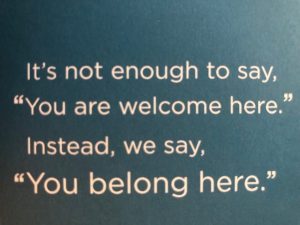
On the screen is part of a flyer from the Rashi School, a Reform day school in the Boston area, which says: “It’s not enough to say ‘you are welcome here.’ Instead, we say, ‘you belong here.’” That’s the difference.

Our movement’s resolutions concerning other marginalized groups all set a goal of inclusion: they speak of goals “[T]o integrate fully all Jews into the life of the community regardless of sexual orientation;” “[W]elcoming communities of meaningful inclusion, enabling and encouraging people with disabilities … to participate fully …;” or of “[C]ommitment to the full equality, inclusion and acceptance of people of all gender identities and gender expressions.”

But the movement’s latest resolution on interfaith marriage commits only says partners from different faith backgrounds “deserve a warm welcome” and appreciation, while also encouraging conversion, “becoming a fully Jewish family.”

Like every other marginalized group, it stands to reason that interfaith couples will not stay unless they are made to feel that they truly belong.  That’s what inclusion means.

If we require people to convert in order to feel that they belong, they won’t and we will dwindle. I’m wearing a sticker with a large “72%” – that’s the rate of interfaith marriage among non-Orthodox Jews, and it means that 84% of new households being formed that include at least one non-Orthodox Jew are interfaith households.

How do we enable people who are not Jews to feel that they truly belong in Jewish communities? We need three things: a new understanding of interfaith marriage, and adapted attitudes and policies that support full inclusion.

First, in the traditional view, Judaism is for Jews; what matters is “being” Jewish, part of the Jewish people. Those who identify as Jews are “in;” a partner who is not a Jew is “out” or “other.” We need a new understanding that Judaism is not just for Jews, it is for people who are “doing” Jewish, whether or not they identify as Jews, in a community that consists of other Jewishly-engaged people. This is radical, because it stands the traditional view on its head.

A rabbi told me once that it didn’t make sense for someone to say, “I live Jewishly but I’m not a Jew.” We need a new understanding of interfaith marriage in which that makes perfect sense.

Second, inclusion requires an adaptation of underlying attitudes towards the group to be included. That means considering interfaith families as equal to inmarried families, and partners from different faith backgrounds as equal to Jews. Unfortunately, examples of expressions of negative attitudes abound. Expressing a preference that our children marry Jews delivers a message of disapproval to the 72% of them who will intermarry anyway. The Hebrew Union College policy to not admit or ordain intermarried rabbinic students sends a message of disapproval. Feeling disapproved of is not conducive to feeling belonging.

Third, inclusion requires adaptive change in the established system with which the group to be included engages. As a consultant explains: “Modes of worship may need to broaden. Methods of decision-making may need to change. And interaction patterns among members may need to evolve.”

Adaptive change means not just considering, but treating interfaith families and partners from different faith backgrounds as equal. What leadership roles can partners from different faith backgrounds take? In what rituals can they participate? How will we explain those policies and communicate our invitations to engage?

I received a very negative email from a rabbi a few days ago. He said that boundaries are essential to the survival of our culture; that if partners from different faith traditions can do everything Jews can do, Jewish identity would be meaningless and why would anyone convert; that it’s like citizenship, where aliens have certain rights but can’t vote; and that churches don’t allow everyone to take communion.

Here’s how I responded. Yes, we can maintain boundaries, and apply the citizenship analogy – and we won’t have anyone left to engage in our beautiful culture that we want to survive – remember the 72%/84%. Hopefully people convert because it is existentially important to them to identify with the way that they live, not so that they can exercise certain rights that others can’t. I’m not an expert on communion, but my understanding is that it can only mean affirming the divinity of Jesus; that’s qualitatively different from partners from different faith traditions feeling that they belong, that they are part of the “us” to whom God gave the Torah, and can authentically say a prayer thanking God for doing so.