
I was busy this month with three presentations on what’s necessary for interfaith families and partners from different faith backgrounds to feel belonging in Jewish settings: with Cohort 5 of the 18Doors Rukin Fellows on March 10, with students and faculty at a lunch & learn at the Hebrew College Rabbinical School on March 17, and at an Academy for Jewish Religion/CA colloquium of students and alumni on March 30.
But I can’t say, based on this small sample, that Jewish leaders are becoming more interested in engaging interfaith families.
Talk
There is some discussion going on. There was an interesting commentary in the British Jewish press on the US Conservative movement’s recent report on intermarriage, which we’ve discussed at length in previous newsletters. I learned that the European branch of the movement, the International Rabbinical Assembly, is “studying the impact of intermarriage on our communities and assessing whether our traditional responses are achieving their goals or whether different approaches are necessary.”
At the Jewish Funders Network’s conference this month, according to eJP, “the theme of new voices in the philanthropic world was a topic,” and Jonah Platt talked about the opportunity to “start to create new institutions, or reprioritize our current ones in the way that they’re operating, and bring in all these other people who have not been engaged and want to be and don’t necessarily know how or what to do, but want to do it.” But if there was specific talk about engaging interfaith families, it wasn’t reported.
In early March there was an “unconference” in Miami to talk about the renewal of American Jewry. eJP reported that “Many issues already firmly in the Jewish communal zeitgeist came up repeatedly during panels,” including “the importance of better welcoming interfaith families.” An attendee confirmed to me that there appeared to be much interest in interfaith families. But shouldn’t representatives from organizations that work with and advocate for inclusion of interfaith families be included in gatherings of this type if the goal is real progress?
Research
I was pleased to see that the March 25 issue of the CASJE (Collaborative for Applied Studies in Jewish Education) Research Digest featured studies about interfaith families and their children, and that it mentioned our paper, What Recent Studies Reveal About Interfaith Family Inclusion.
The digest points to “a clear trajectory: in the years ahead, a growing share of Jews in the US will have only one Jewish parent;” that “more children of intermarried couples are identifying as Jewish because Jewish institutions became significantly more welcoming and inclusive toward intermarried families starting in the 1980s and 1990s;” and that “participation in Jewish educational opportunities can play a critical role in supporting children of intermarriage growing into adults who identify as Jewish and participate actively in Jewish life.”
These kinds of research results should support more programmatic efforts to be inclusive of interfaith families and to engage their children in Jewish educational activities. Whether they will – not clear.
Inaction/Action
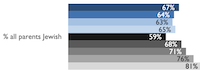 Data in the appendix of a new study by the Cohen Center of 2025 Birthright Israel trips shows that the percentage of trip applicants who indicated that their parents were intermarried (those who did not say “all parents Jewish”) ranged between 33% and 37% between 2017 and 2020, reached a high of 41% in 2021, then declined to 32% in 2022, 29% in 2023, 24% in 2024, and a low of 19% in 2025. Given the trajectory of more Jews having one Jewish parent, it’s clear that Birthright needs to attract more applicants from that category, not fewer.
The study notes that the impact of trip participation appears to be greater among political liberals and on those who come from less engaged Jewish backgrounds, and states that attracting liberal Jews and those with less exposure to Jewish education is key to Birthright’s continued success. But it doesn’t say anything similar, that attracting children from interfaith families is key to Birthright’s continued success.
One concrete positive development this month was “Creating Belonging for Multiheritage Families,” an article by Michelle Barton and 18Doors’ Miriam Wajnberg in the journal of Prizmah, the network of Jewish day schools. The article relates the process by which the Shlenker School in Houston, with help from 18Doors, addressed the question parents raising children in interfaith families can ask: whether their family fully belongs.
“As family structures and Jewish journeys diversify, schools are called to examine whether their policies, cultures, language and rituals truly foster belonging or simply allow participation without full inclusion. Belonging is not synonymous with enrollment or participation. It reflects whether families feel seen, valued and confident that their full identities fit within the life of the school.”
The authors describe three obstacles that interfaith families face to belonging in Jewish communities and day schools: (1) an insider/outsider element; (2) a stigma against those who marry someone from another background; (3) “The belief in matrilineal descent creates barriers for multiheritage families to fully feel a sense of belonging in Jewish communities and schools.” “Even when a child from a multiheritage family may be fully accepted in one denomination or setting, that acceptance may not extend to all Jewish settings, resulting in ‘othering.’”
It is very heartening to see day schools focusing on interfaith family belonging. Almost twenty years ago, in 2007, for the tenth anniversary of the Partnership for Excellence in Jewish Education (which became part of Prizmah in 2016), I wrote “Interfaith Families and the Future of Jewish Day Schools.” I said:
“Schools can make themselves more accessible to these [intermarried] parents by making explicit statements of welcome, couching their specifically Jewish values in universal terms, and providing extra explanatory information on Jewish holidays, rituals and culture.” “Day schools could become laboratories that attempt to resolve the thorny issues of recognition. Every participant in a Jewish day school community could be considered – in some way – part of the Jewish community and people.”
 It’s almost twenty years since I said, “Imagine how radically different the future of Jewish day schools would be if even ten percent of this growing population [of interfaith families] chose Jewish day schools.” We’re not even close to that yet – the recent Boston 2025 study found that 1% of children of interfaith families attended day schools compared to 23% of children of inmarried families. Efforts to foster belonging could lead to more enrollment. The many funders who support day schools might consider directing some of their funding to those efforts.
In other news
I think Mira Fox was too dismissive of something in “Is Goy a Slur, an Antisemitic Dogwhistle or a Word for Non-Jews?” She says “goy” “simply means ‘non-Jew,’ or foreign nation which isn’t inherently insulting; Jews are far from the only group to have a term for outsider – think gringo in Spanish or farang in Thai. This can, of course, be exclusionary. There is certainly the sense that outsiders cannot understand or participate in certain activities of an in-group – an idea that is not limited to Jews. And sometimes that is used to discriminate or insult.”
I say that for people in interfaith relationships, any use of “goy” by Jews not just can be exclusionary, it is exclusionary and makes the partners from different faith backgrounds feel like outsiders. Even if the word has innocent meanings, I think any use of it by Jews is a bad idea.
Also noted:
- A “Dear Annie” advice column addresses “Balancing Respect in an Interfaith Relationship”
- An interesting discussion of conversion in the Catholic journal Commonweal, “Waiting for the Lightning Bolt: Conversion in ‘Nobody Wants This’”
Leave a Reply