Boston 2025 CJP Survey
CJP released the 2025 Greater Boston Jewish Community Study on February 12. As readers of this newsletter know, I am most interested in what research reveals about interfaith families’ feelings of belonging in Jewish communities (see What Recent Studies Reveal About Interfaith Family Inclusion). That’s because for liberal Judaism to thrive, more interfaith families need to be more Jewishly engaged, and for people to engage, they need to feel belonging.
Most of the data relevant to interfaith families’ feelings of belonging is not reported in the thirteen individual reports that make up the Boston study. My understanding is that CJP is planning to make available a tool that will enable anyone to make inquiries about the data. So we need to be patient.
You can find what I have to say about the study in Review and Analysis of the Interfaith Marriage Data in the 2025 Greater Boston Jewish Community Study. I will update the review when more data is available. In the meantime, some highlights:
- The Boston Jewish community is heavily and increasingly intermarried – 50% of married/partnered Jewish adults are in interfaith relationships; of marriages since 2020, 58% were interfaith.
- 69% of children in interfaith families are being raised Jewish in some way (the breakdown of Jewish only, Jewish and something else, etc. is not currently reported). Fewer children of interfaith families have Jewish education – 16% are in part-time K-8 programs compared to 61% of children of inmarried families.
- CJP states that “interfaith households… are an integral part of the Greater Boston Jewish Community.” As mentioned above, data on how interfaith families feel about their connection to the Jewish community is not currently available, although it is for LGBTQIA+ Jews, Jews of color, Jews with disabilities, Russian-speaking Jews, Israeli Jews, and Jews of Sephardic or Mizrahi heritage.
- There are indications in what’s been reported that interfaith families are less connected to the local Jewish community, which would be consistent with national and other local studies. The study says that “While most Jews in interfaith homes say they feel welcome, they are significantly less likely to participate in Jewish communal life.” The report says that those who feel connected and part of the local Jewish community are more Jewishly engaged. But only 22% of those who feel part of the local Jewish community are intermarried; 78% are inmarried.
- There were follow-up interviews and focus groups with community members that gave “more insight on their feelings of inclusion and belonging.” But “most” of these community members “are avid synagogue participants who generally feel welcome in the spaces they choose to be in.” Apparently the insights do not reflect input from less engaged community members.
There is a lot of good news in the study. It’s great that a high percentage of children of interfaith families are being raised Jewish, but it’s worrisome that relatively few are getting Jewish education. It’s great that interfaith families generally feel welcome, but it’s worrisome that that doesn’t translate into feelings of connection that foster engagement. I hope a major part of CJP’s implementation efforts following the study will focus on fostering interfaith families’ feelings of belonging and providing Jewish education for their children. We look forward to what further data shows when it becomes available.
A Message for Funders
The Jewish Funders Network International Conference is coming up. I’m not aware that interfaith family inclusion will be a topic of discussion. But there was a great essay by Jennifer Laszlo Mizrahi about how Jewish disability inclusion efforts grew that suggests what funders have the power to do. I’m replacing “disabilities” with “interfaith” in the following quote to illustrate what I hope they will do:
[A] small group of Jewish philanthropists and foundations began asking a simple but transformative question: What would it take for people [in interfaith relationships] to be fully included in Jewish life? A group of people active in Jewish philanthropy who had found that their families were not welcome in Jewish life due to [interfaith family inclusion] issues connected through the Jewish Funders Network. Together, they helped bring [interfaith family] inclusion into the philanthropic spotlight, and other philanthropists joined as allies.
Coincidentally, an essay about the JCC movement’s approach to disability inclusion expressed the importance of a comprehensive approach that is relevant to all inclusion efforts: “What we’ve learned is simple: inclusion is possible when shared, systematized and woven into the fabric of an entire movement. … With centralized leadership and shared language, frameworks and responsibility, we all can expand inclusion efforts and empower each other to join in this vitally important work.”
How We Talk About Conversion
Mijal Bitton wrote a beautiful essay about conversion. As I read it, though, I couldn’t help but think that it implied that partners from different faith backgrounds who do not convert remain outsiders. That is not an inclusive message that encourages interfaith families to be Jewishly engaged. How can we talk about conversion without doing that?
 Bitton says that after the mikveh, “Someone who stood at the edge now stands inside;” that those “who bind their fate to the Jewish people by choice, are not meant to remain at the edges. They are meant to be received as insiders, with standing and responsibility.” She refers to the “rabbinic claim that converts are said to have been present at Sinai” and says that “to have stood at Sinai, whether by birth or by choice, is … to accept responsibility for a covenant that is still being made.”
But there are other textual claims that it was a mixed multitude that stood at Sinai, including the strangers in the camp, who can be understood to have accepted responsibility for a covenant to be Jewishly engaged.
This kind of messaging by Jewish leaders about the standing of partners from different faith backgrounds matters. I was struck by a comment in a very different context, a New York Times opinion piece about the conflict in Minneapolis, that expressed the importance of recognition by others:
“[W]ho we are is not just the idea we have of ourselves. It is also how others see us. The German philosopher Hegel elucidated this truth: The essence of our identity is not something we make on our own – it requires the recognition of others to be real. How we are perceived by others doesn’t just reflect who we are. It constitutes it.”
A Message for Rabbis
The CCAR convention is coming up. I’m not aware that interfaith family inclusion will be a topic of discussion. I urge Reform rabbis to read this very beautiful “Prayer for a Community of Belonging” by Rabbi Fred Greene. It sends the kind of inclusive message of recognition that we need to send. Do the partners from different faith backgrounds in your congregations feel noticed, named, known, needed and nurtured?
Honeymoon Israel Fosters Belonging
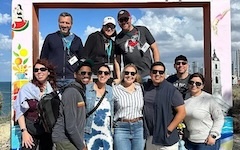 “‘It’s Complicated’ to Connected: Honeymoon Israel and Jewish Belonging Post 10/7” is a beautiful article by Honeymoon Israel staffer Emma Dunn. It describes how Honeymoon Israel fosters a sense of belonging among partners from different faith backgrounds. Dunn relates how Avraham Infeld speaks to trip participants about Jewish peoplehood as a shared sense of responsibility that “Jews by birth, Jews by choice, and partners who had come to Jewish life through love and relationship” (my emphasis) can develop. Infeld asks, “If you are choosing to build your life connected to the Jewish people, how will you show up for one another now and into the future?”
Dunn writes that “Honeymoon Israel offers a space where Jewish and mixed-heritage couples can explore their place in the Jewish people with honesty and care…. [C]ouples experience a broad and generous welcome into Jewish peoplehood. When they return home, they carry that sense of belonging with them and continue building Jewish life together.”
Left Out
There were several instances this month where the issue of engaging interfaith families could have been mentioned but wasn’t. Moment Magazine listed fifty Jewish innovators over the past fifty years; there was just one explicit reference to engaging interfaith families, a mention of Paul and Rachel Cowan’s 1989 book, Mixed Blessings. The Sapir journal published a conversation between Joshua Foer and William Foster on “What Makes a Moonshot?” and Charles Bronfman and Jeffrey Solomon offered “We Backed Birthright Israel. Now It’s Time for More Big Ideas for a Post-Oct. 7 World;” efforts to engage interfaith families weren’t mentioned as potential moonshots or big ideas.
Should the Jewish Press Survey Whether Intermarriage Is a Threat to Jewish Continuity?
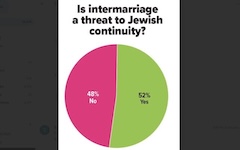 The Pittsburgh Jewish Chronicle polled its readers, asking “Is intermarriage a threat to Jewish continuity?” 52% said yes, 48% said no. Asking that question and publicizing that result sends a message to interfaith couples that their marriage is viewed negatively by many Jews, discouraging couples who might be potentially Jewishly involved.
The paper published some of the comments it received. Some were positive about interfaith marriages resulting in children being raised as Jews; some were negative – “Of course it’s a threat. You can pretend it’s not and do a bunch of interfaith stuff but it’s not authentic Jewish identity.” My favorite: “Intermarriage will continue regardless of the opinions of rabbis or families. Either the Jewish community finds a way to embrace these marriages or lose members of the community. One thing is certain, we lose if we don’t welcome them.”
In Other News
- In the outright hostile to interfaith marriage department, an article on the Aish website says that the greatest threat facing the Jewish people isn’t antisemitism, it’s interfaith marriage (or the assimilation that is the result of interfaith marriage), and an ultra-Orthodox authority in Israel told followers not to go to the very wonderful ANU Museum of the Jewish People in Tel Aviv because, he says, it promotes interfaith marriage.
- Israeli political parties are advancing legislation that would extend control over the entire Western Wall to the Orthodox rabbinate, which would result in Reform and Conservative Jews not being able to have prayer services there, and even criminalizing their egalitarian prayer at the Wall. (Forward, Times of Israel, JTA)
- Jack and Quinn Hughes, whose parents are an interfaith couple, are featured in a JTA story as Jewish Team USA hockey stars; the very sad news about Savannah Guthrie’s mother generated a story about her interfaith marriage.
- I happily stumbled on the website of Mosaic Law Congregation, a Conservative synagogue in Sacramento, that has a vibrating banner on its home page that reads “We Welcome Interfaith Families.”
 Noting that only about 22% of overnight campers come from interfaith families, 18Doors’ Adam Pollack says “That gap [with the high rate of interfaith marriage] tells us camps are not yet representative of the Jewish population today. We’re trying to find ways to make Jewish overnight camp accessible and appealing to families who already consider themselves part of the Jewish community but may not feel certain that camp is for them…. We know how transformative camp can be. We want all Jewish kids – including those from multi-heritage families – to have access to that experience.”
 The report says that the Working Group “commissioned thirteen informal position papers from historians, social scientists, and rabbis.” I was invited to make a
  ATRA released a fascinating
  Rabbi Lisa Rubin, who runs the very successful Center for Exploring Judaism program based at Central Synagogue, had an interesting take on the show, “
 The Reconstructionist journal Evolve published an interesting
  The Boston Globe published a story about a Massachusetts synagogue in which a gratuitous comment seemed to partly blame intermarriage for its closing. I wrote the following
  The false idea of demographic loss also came up in a short podcast, “
 I’m looking forward to participating in the
  Embark is a relatively new program, now part of Mem Global, for young adult interfaith couples. Rabbi Ari Perten of Mem Global and Ezra Kopelowitz,
  New research about reinventing Hebrew school (the
  Rabbi Liz PG Hirsch, executive director of
  Negative attitudes about interfaith marriage are still with us. Hey Alma’s advice columnist