March 2026 News: How Interested Are Jewish Leaders in Engaging Interfaith Families? Some Talk, and Research Support, But Little Action

|

I was busy this month with three presentations on what’s necessary for interfaith families and partners from different faith backgrounds to feel belonging in Jewish settings: with Cohort 5 of the 18Doors Rukin Fellows on March 10, with students and faculty at a lunch & learn at the Hebrew College Rabbinical School on March 17, and at an Academy for Jewish Religion/CA colloquium of students and alumni on March 30.

But I can’t say, based on this small sample, that Jewish leaders are becoming more interested in engaging interfaith families.

Talk

There is some discussion going on. There was an interesting commentary in the British Jewish press on the US Conservative movement’s recent report on intermarriage, which we’ve discussed at length in previous newsletters. I learned that the European branch of the movement, the International Rabbinical Assembly, is “studying the impact of intermarriage on our communities and assessing whether our traditional responses are achieving their goals or whether different approaches are necessary.”

At the Jewish Funders Network’s conference this month, according to eJP, “the theme of new voices in the philanthropic world was a topic,” and Jonah Platt talked about the opportunity to “start to create new institutions, or reprioritize our current ones in the way that they’re operating, and bring in all these other people who have not been engaged and want to be and don’t necessarily know how or what to do, but want to do it.” But if there was specific talk about engaging interfaith families, it wasn’t reported.

In early March there was an “unconference” in Miami to talk about the renewal of American Jewry. eJP reported that “Many issues already firmly in the Jewish communal zeitgeist came up repeatedly during panels,” including “the importance of better welcoming interfaith families.” An attendee confirmed to me that there appeared to be much interest in interfaith families. But shouldn’t representatives from organizations that work with and advocate for inclusion of interfaith families be included in gatherings of this type if the goal is real progress?

Research

I was pleased to see that the March 25 issue of the CASJE (Collaborative for Applied Studies in Jewish Education) Research Digest featured studies about interfaith families and their children, and that it mentioned our paper, What Recent Studies Reveal About Interfaith Family Inclusion.

The digest points to “a clear trajectory: in the years ahead, a growing share of Jews in the US will have only one Jewish parent;” that “more children of intermarried couples are identifying as Jewish because Jewish institutions became significantly more welcoming and inclusive toward intermarried families starting in the 1980s and 1990s;” and that “participation in Jewish educational opportunities can play a critical role in supporting children of intermarriage growing into adults who identify as Jewish and participate actively in Jewish life.”

These kinds of research results should support more programmatic efforts to be inclusive of interfaith families and to engage their children in Jewish educational activities. Whether they will – not clear.

Inaction/Action
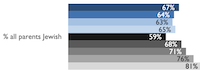
Data in the appendix of a new study by the Cohen Center of 2025 Birthright Israel trips shows that the percentage of trip applicants who indicated that their parents were intermarried (those who did not say “all parents Jewish”) ranged between 33% and 37% between 2017 and 2020, reached a high of 41% in 2021, then declined to 32% in 2022, 29% in 2023, 24% in 2024, and a low of 19% in 2025. Given the trajectory of more Jews having one Jewish parent, it’s clear that Birthright needs to attract more applicants from that category, not fewer.

The study notes that the impact of trip participation appears to be greater among political liberals and on those who come from less engaged Jewish backgrounds, and states that attracting liberal Jews and those with less exposure to Jewish education is key to Birthright’s continued success. But it doesn’t say anything similar, that attracting children from interfaith families is key to Birthright’s continued success.

One concrete positive development this month was “Creating Belonging for Multiheritage Families,” an article by Michelle Barton and 18Doors’ Miriam Wajnberg in the journal of Prizmah, the network of Jewish day schools. The article relates the process by which the Shlenker School in Houston, with help from 18Doors, addressed the question parents raising children in interfaith families can ask: whether their family fully belongs.

“As family structures and Jewish journeys diversify, schools are called to examine whether their policies, cultures, language and rituals truly foster belonging or simply allow participation without full inclusion. Belonging is not synonymous with enrollment or participation. It reflects whether families feel seen, valued and confident that their full identities fit within the life of the school.”

The authors describe three obstacles that interfaith families face to belonging in Jewish communities and day schools: (1) an insider/outsider element; (2) a stigma against those who marry someone from another background; (3) “The belief in matrilineal descent creates barriers for multiheritage families to fully feel a sense of belonging in Jewish communities and schools.” “Even when a child from a multiheritage family may be fully accepted in one denomination or setting, that acceptance may not extend to all Jewish settings, resulting in ‘othering.’”

It is very heartening to see day schools focusing on interfaith family belonging. Almost twenty years ago, in 2007, for the tenth anniversary of the Partnership for Excellence in Jewish Education (which became part of Prizmah in 2016), I wrote “Interfaith Families and the Future of Jewish Day Schools.” I said:

“Schools can make themselves more accessible to these [intermarried] parents by making explicit statements of welcome, couching their specifically Jewish values in universal terms, and providing extra explanatory information on Jewish holidays, rituals and culture.” “Day schools could become laboratories that attempt to resolve the thorny issues of recognition. Every participant in a Jewish day school community could be considered – in some way – part of the Jewish community and people.”
It’s almost twenty years since I said, “Imagine how radically different the future of Jewish day schools would be if even ten percent of this growing population [of interfaith families] chose Jewish day schools.” We’re not even close to that yet – the recent Boston 2025 study found that 1% of children of interfaith families attended day schools compared to 23% of children of inmarried families. Efforts to foster belonging could lead to more enrollment. The many funders who support day schools might consider directing some of their funding to those efforts.

In other news 

I think Mira Fox was too dismissive of something in “Is Goy a Slur, an Antisemitic Dogwhistle or a Word for Non-Jews?” She says “goy” “simply means ‘non-Jew,’ or foreign nation which isn’t inherently insulting; Jews are far from the only group to have a term for outsider – think gringo in Spanish or farang in Thai. This can, of course, be exclusionary. There is certainly the sense that outsiders cannot understand or participate in certain activities of an in-group – an idea that is not limited to Jews. And sometimes that is used to discriminate or insult.”

I say that for people in interfaith relationships, any use of “goy” by Jews not just can be exclusionary, it is exclusionary and makes the partners from different faith backgrounds feel like outsiders. Even if the word has innocent meanings, I think any use of it by Jews is a bad idea.

Also noted:

November 2025 News: Laura Lauder and Embark; Rabbis and Interfaith Marriage in ATRA Study; Nobody Wants This; Chosenness

|

Laura Lauder and Embark

eJP ran an important interview of philanthropist Laura Lauder about the Embark program she launched and supports, now as part of Mem Global. The goal of Embark is “to have [non-Jewish partners] feel comfortable in their identity as a parent of Jewish children and as a member of a Jewish household. …[W]e are here to provide you with an educational experience with a cohort of other people in your same shoes, to enable you to decide for yourself, and whatever you decide, what we hope is that the decision is to make a warm, loving Jewish home and raise your children Jewish.”

The questions by eJP’s Jay Deitcher seem hostile to Lauder’s positions. He asks, “Do you ever fear that changing expectations of children related to interfaith relationships and intermarriage is a mistake? That the community’s leniency has gone too far….” He suggests that Embark does not strengthen Jewish community when he asks, “[S]tudies show that Jews who marry other Jews have stronger engagement with Judaism. Why not focus your effort on pushing for a stricter Judaism, or pushing for day schools or focusing your finances on strengthening the Jewish community?” Even the title given to the interview – “Still preferring Jewish marriages, Laura Lauder pledges $500K annually to boost interfaith couples” – is slanted; Lauder never says that she prefers “Jewish marriages.” The title also begs the question, with a 72% rate of interfaith marriage among non-Orthodox Jews, what is a Jewish marriage today?

Lauder’s position is laudable: “It’s not a conversion program…. [M]y sense is that we have to be inclusive and embrace these families who are interfaith and who want to raise their kids Jewish, so we want to provide a vehicle to enable them to do that.”

The Embark program includes a unit on Israel, about which Lauder says: “[W]e hope that these young people will keep their views on the issue on the Gaza war out of their decision as to how much they want to incorporate Judaism in their lives. I’m hoping that this particular Israeli government doesn’t dissuade them from wanting to have more Judaism in their lives.”

Rabbis and Interfaith Marriage

ATRA released a fascinating study conducted by Rosov Consulting about the rabbinate. Many of the study’s observations relate to interfaith families.

  • Congregations apparently want to be inclusive of interfaith families. In searching for rabbis, “inclusivity is a key characteristic of desired candidates. This inclusivity appears to be aimed at interfaith families … and those who are not halakhically Jewish but still seek to participate in community life. The postings include phrases [that reflect] a need for openness and acceptance. The candidate is characterized as a bridge between tradition and modernity, which requires a personality that is open and adaptable. This focus is clearest in positions aimed at fostering community with younger demographics (e.g., college students), but it is also present in many congregations seeking to remain relevant in a rapidly evolving society.”
  • More rabbis and future rabbis have interfaith backgrounds or relationships; among current rabbinical students, 20% were not raised Jewish or not raised exclusively Jewish. This creates issues for them.
  • Some students were “deterred by concerns, whether true now or not, that some aspect of their identity would disqualify them from being able to attend rabbinical school. Perceptions of how inclusive various rabbinical schools are for … students in interfaith marriages … shaped decisions about where to attend.”
  • “For some interviewees, coming from interfaith or non-Jewish backgrounds created feelings of exclusion and added hurdles in the admissions process. They described concerns that their backgrounds might be scrutinized more heavily, requiring them to prove their Jewish authenticity or justify their place in rabbinical training in ways that peers from more traditional backgrounds did not face.” One comment: “I have one non-Jewish parent, and that is a problem with a lot of people in the Jewish community, especially because it’s my mother. So, there’s plenty in the community who look at that and go, ‘you’re not really Jewish.'”

Nobody Wants This

Rabbi Lisa Rubin, who runs the very successful Center for Exploring Judaism program based at Central Synagogue, had an interesting take on the show, “Conversion isn’t a solo act. So why is the rabbi in ‘Nobody Wants This’ acting alone?” Rubin sees interfaith marriage as “an extraordinary opportunity for growth. Interfaith relationships, approached thoughtfully, can be pathways into Judaism rather than exits from it.” Her main point is that Rabbi Noah shouldn’t have tried to mentor Joanne himself, but rather should have connected her to a program – like the Center for Exploring Judaism – which she describes beautifully. She sees the show’s title as ironic, because “Jews should want this… [W]e should want our communities to see interfaith love not as a threat, but as a chance to expand the circle.”
For more on the Nobody Wants This front, it looks like there will be a season three, but the speculation is that Joanne will convert. I won’t get the show I was hoping to see, about a happily married, Jewishly-engaged, interfaith couple.

Chosenness

The Reconstructionist journal Evolve published an interesting essay by Rabbi Amichai Lau-Lavie about chosenness. At his congregation, Lab/Shul:

“[W]e have replaced the blessing at the Torah with asher bakhartanu im kol ha’amim – ‘Who has chosen us, along with all other peoples, to live this life with love.’ That is because I estimate that a good half of my community is not necessarily Jewish according to Jewish law. They are Jewish, they are Jewish-adjacent, they are people who have chosen to live with Jewish people. Some are Jewish patrilineally. Others, matrilineally. Still others, Jews by choice. We are human, and being Jewish is part of who we are.”

In Other News

  • An article from Religion News Service about how Vice President Vance hopes his Hindu wife converts to Christianity quotes our friend Susan Katz Miller, who aptly says, “To respect your partner and everything they bring to the marriage – every part of their identity – is integral to the kind of honesty that you need to have in a marriage.” And, “pressuring one’s spouse to convert or even hoping they would convert is not a good basis for a successful marriage.”
  • The Jewish Education Project’s otherwise excellent “What Will Jewish Education Look Like in 2050” does not mention any emphasis on reaching or including interfaith families.
  • I was not able to attend the JFNA’s General Assembly. I heard that there was discussion of engaging interfaith families, but have not seen anything published or public on that issue. An essay before the GA talked about “unveiling innovative platforms and programs that foster an inclusive culture and provide opportunities for deeper Jewish learning and involvement for those who may have been disconnected” before October 7. In an interview after the GA, JFNA’s CEO Eric Fingerhut said “There are great opportunities to increase the number of people engaged in Jewish life and education.” It remains to be seen how much priority will be given to engaging interfaith families.

October 2025 News: Lessons from Research on Interfaith Families’ Belonging; What Season Two of Nobody Wants This Gets Right

|

Today’s eJewishPhilanthropy Op-ed: What Research Reveals About Interfaith Families’ Feelings of Belonging

For the first time ever, we held this email newsletter beyond the end of the month, so that we could tell you that today, eJewishPhilanthropy published our op-ed, Making Interfaith Families a Valued Part of Jewish Communities.

We’ve been working for many months on a project to gather and review all of the data on interfaith families’ feelings of belonging in a dozen years’ worth of research: two national Pew reports, twenty-six local community studies by the Cohen Center at Brandeis, one quantitative and three qualitative Cohen Center studies of interfaith families, a recent qualitative study led by Tobin Belzer and a recent local community study by Rosov Consulting.

Today’s op-ed summarizes the Center’s detailed paper, What Recent Studies Reveal About Interfaith Family Inclusion. The paper’s conclusions:

  • people in interfaith relationships do not feel very connected to or part of the Jewish people or their local Jewish community, and significantly less so than inmarrieds do;
  • interfaith families, and partners from different faith backgrounds, want to feel like part of Jewish communities, but instead persistently feel othered and excluded;
  • not having many Jewish friends or knowing many people in the Jewish community may contribute to not feeling belonging, and could be countered by extending personal invitations;
  • policies that restrict participation contribute to not feeling belonging, and policies around diversity and inclusion being made explicit are a welcoming factor; and
  • clear communication that interfaith families are a valued part of the Jewish community is needed to help move interfaith families from othering to belonging.

This was a major effort for the Center and we are grateful to eJewishPhilanthropy for publishing the op-ed and to Rachel Kohn for her careful and helpful editing.

We hope the information contained in the paper will be helpful to everyone who is working to foster more Jewish engagement among interfaith families. We’re very interested in discussing the paper and in your feedback; please contact us at info@cfrij.com

Season Two of Nobody Wants This

There seemed to be a lot of buzz about the show before it was released, but not so much afterwards. My take, in the Times of Israel blogs: What Season Two of Nobody Wants This Gets Right About Interfaith Relationships.

Season two’s messaging is much improved. Most of the negativity about interfaith marriage from the first season is gone. The story throughline, about whether Joanne will convert, illustrates how pressure to do so is counter-productive. It hints at what inclusive attitudes and communities would be like, including that partners from different faith backgrounds should be accepted exactly as they are.

By focusing on conversion, the show misses the opportunity to depict a relationship and community where an interfaith couple, and especially the partner from a different faith background, can find a sense of belonging. Perhaps that will come in season three?

Some articles on the show worth reading:

In other news:

  • I was delighted to see that Sheila Katz will be the Chief Jewish Life Officer at JFNA overseeing a portfolio that seeks to engage Jews of all backgrounds including “initiatives supporting multifaith and mixed-heritage families.”
  • A nice story from the Forward’s Bintel Brief about interfaith families and Jewish cemeteries; there’s not much new in the article, but it highlights the halachic/non-halachic divide on this issue.
  • 18Doors launched its largest B’Yachad cohort yet in Atlanta.
  • A nice story in The Conversation by Samira Mehta on interfaith weddings weaving traditions together.
  • Another negative story about Israel’s Interior Ministry making life difficult for converts.
  • Finally, speaking of pressure to convert – and I try to keep politics out of this newsletter – Vice President Vance seems to have applied some public pressure, then tried to walk it back hoping that his Hindu wife would become Catholic.

October 2024 News from the Center

|

Nobody Wants This

The news this month was pretty much all about the Netflix hit show, Nobody Wants This, in which “hot rabbi” Noah falls for Joanne who’s not Jewish; she says she’ll convert then realizes she’s not ready; he appears to choose to stay with her which means he won’t get the promotion to senior rabbi he’s always wanted.

The Forward published my take on it, What “Nobody Wants This” gets wrong about interfaith relationships today. I enjoyed watching the show. It depicts some aspects of Jewish life in a refreshing, positive way, while it’s portrayal of Jewish women is awful.

But the messaging about interfaith relationships is terrible. It suggests that nobody in the Jewish community wants interfaith relationships; that they don’t produce Jewish children; and that if the partner from a different faith background doesn’t convert, the Jewish partner will lose their Jewish identity (or in Rabbi Noah’s case, his dream to be senior rabbi).

While all of that is wrong, the show’s exaggerations do reflect an underlying reality – many interfaith couples do not feel a sense of belonging to the Jewish people, because of lingering negative attitudes about interfaith marriage. I’m hoping that Season Two will change the messaging and show a happy interfaith family raising children with Judaism; with Rabbi Noah becoming senior rabbi at a congregation that accepts him as intermarried; and perhaps even with Joanne taking an Introduction to Judaism course, whether or not it leads to conversion right away.

In a NY Times interview, the show’s co-producer, Sara Foster, says that “to draw an audience in for 10 episodes you need conflict.” I get that, and maybe what I’m hoping for doesn’t provide that. But given the messaging about interfaith marriage, let alone the stereotyping of Jewish women, it seems tone-deaf to me when her sister Erin Foster, the show’s writer and co-producer, says she feels fortunate to have shined “a positive light on Judaism and Jewish people and Jewish culture.” I feel the same way about Sara’s statement that “for there to be a Jewish romantic comedy that is number one across the world… is good for Jewish people.”

I tried to keep track of all of the writing about the show but can’t report on everything, let alone all the social media buzz. A Canadian academin, Celia Rothenberg, thinks that the stereotypes and depiction of interfaith marriage is harmful. I especially like Rabbi Denise Handlarski’s piece, in Hey Alma, I’m a Rabbi in an Interfaith Marriage — Here’s What I Think About ‘Nobody Wants This’; Lior Zaltman’s piece in Kveller, Should Jews Want Netflix’s ‘Nobody Wants This?’; Jessica Radloff’s piece in Glamour, Netflix’s Nobody Wants This and the Persistent Jewish Stereotype; and Keren McGinity’s piece in JTA, Netflix’s ‘Nobody Wants This’ casually celebrates Judaism. I want a second season.

There were other pieces in the NY Times and Time and Moment; an interview in the LA Times with and a profile of Erin Foster and her response to criticism of the show; a piece by Samira Mehta that puts the show in the context of past plays and movies featuring Jewish men dating women from different faith backgrounds; Rabbi Talia Kaplan explains “Why the charming ‘hot’ rabbi in ‘Nobody Wants This’ is bad for clergy and congregants everywhere”; an interesting podcast on the show with Conservative rabbis Michael Knopf and Jesse Olitzky; a piece by a British Reform rabbi; even a piece from Australia. Susan Katz Miller reasonably asked why Joanne had to be someone who is an ex-Christian (as opposed to from some other religious background) while “her people” – people who are practicing two faiths in an interfaith relationship – are never represented; she also objected to the pressure on Joanne to convert.

There were even commentaries from the Orthodox community. In a piece on Aish, a Jewish matchmaker says, not in an offensive way, that love cannot conquer all and that marrying within the faith is a foundational value that enriches our lives and communities.

But a piece in Jew In The City, by Allison Josephs, is offensive. She among other things refers to intermarriage as a “cardinal sin” that “leads to the extinction of the Jewish people” and says the non-Orthodox community is “marrying itself out of existence.” She says Rabbi Noah, by choosing Joanne, “becomes part of the extinction of the Jewish people.” Jew In The City describes itself as a nonprofit “dedicated to changing negative perceptions of religious Jews and making engaging and meaningful Orthodox Judaism known and accessible. This is achieved by highlighting an approach based on kindness, tolerance, sincerity, and critical thinking.” Tolerance?

Conservative Movement News

Just as this newsletter was about to be sent, a powerful essay appeared on Mark Hoffman’s Times of Israel blog: Too Little, Too Late for Conservative Judaism? Hoffman describes the movement’s recent efforts to reassess its approach to interfaith marriage, and discusses a very interesting-sounding presentation by Rabbi Aaron Brusso that I haven’t had a chance to fully watch yet. I’ll plan to comment more in the November email newsletter.

In Other News

This profile of Alexandra Meyer, tells about a young woman who grew up in an interfaith family, with a Jewish mother, with no synagogue or camp or bat mitzvah, who built a Jewish life through her own exploration as a late teen and in college, and is now the managing director of GatherDC,  a nonprofit that helps young adult Jews connect to Jewish life and to each other.