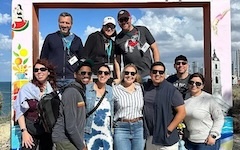
This month’s newsletter is early because we’re going on a trip to Morocco. Two topics have come up this month: whether leaders and organizations are talking – or not – about interfaith family inclusion, and whether Jews are responding positively – or not – to interfaith marriage.
The third season of Nobody Wants This has dropped; stories have already appeared in the Forward, JTA, Kveller, Hey Alma, Unpacked, Primetimer, and MEAWW. We haven’t had a chance to watch yet, and will plan to cover all of the reaction next month.
Let’s Talk About It – or Not
 The Reform Movement. We often point out when interfaith family inclusion could have or should have been discussed, but was not. For example, we had been told by URJ staff that there would not be any programs about interfaith family inclusion at the upcoming Reform movement biennial in December. So we were pleased to learn that there will in fact be a session, co-led by 18Doors’ Rabbi Miriam Wajnberg and Rabbi Ari Perten from Mem Global, about “Welcoming Isn’t Enough: Why Multi-Heritage Families Still Feel Like They Don’t Belong” (programs aren’t listed yet on the website). That was very welcome news – it’s important for the movement not to be complacent, and to do what it can to increase from the current 13% the numbers of interfaith families who are synagogue members.
The Federation World. At the upcoming JFNA General Assembly in November, there will be a session on belonging (on the website look for Monday at 9 am programs):
Everyone wants to build Jewish communities where people feel they belong. Over the past several years, we have invested in new ways of creating connection, welcoming people with different identities and experiences, and designing Jewish life around the needs of a changing community. But what have we learned—and are we seeing the results we hoped for? This conversation will take an honest look at where we are today in fostering belonging. What is working, what is not, and what the next chapter of belonging in Jewish life should look like.
It’s not clear that interfaith families will be part of the discussion. The speakers include several federation officials, including the JFNA’s Rabbi Isaiah Rothstein who directs the Center for Jewish Belonging.
 There’s another interesting sounding session, about “Opening New Doors and Expanding Pathways to Education” (on the on the website look for Monday at 2:45 programs) which will address “a remarkable opportunity” to bring day school and camp experiences “to many more children and families.” It’s not clear whether interfaith families and their children are part of that opportunity.
Related to the GA, the JFNA released a new survey about the “surge” in Jewish engagement post-October 7, which was covered by eJP and JTA. Top-line data and a slide deck are available.
 Over a year ago, we said in our September 2025 newsletter that when JFNA started doing surveys on the surge, they included data on its impact on the engagement of various minority populations, including LGBTQ Jews, Jews of color, Jews with disabilities, financially vulnerable Jews, and, on at least one occasion, on mixed heritage couples. We didn’t see any mention of how minority populations have been impacted in the latest survey release. We were told that JFNA needed to look at that data; it doesn’t seem likely that it will be reported on at the GA.
Project Prism. In last month’s newsletter we wrote about the Project Prism study of young adults funded by the Jim Joseph Foundation. We noted that 21% of respondents said that a “more welcoming or inclusive atmosphere” was a driver of increased relevance and appeal. We expressed interest in knowing whether respondents from interfaith families (58% of the sample) or who were in interfaith relationships said that that meant a more welcoming or inclusive atmosphere with respect to people like them. We’ve been told that further analyses of the data are underway, and look forward to learning more.
David Cygielman, leader of Mem Global, wrote an interesting piece for eJP about how the Project Prism research supports Mem Global’s strategy to build flexible, informal and low pressure home-based spaces. He notes the research finding that to participate in Jewish experiences that create belonging, young adults must already have some sense of connection, but says it’s a “chicken-egg” problem: many young adults don’t have “formative” experiences that contribute to feelings of connection. He asks, “[W]hat about young adults who reach their 20s or 30s without ‘formative’ experiences like day school, summer camp or engagement on college campuses that contribute to feelings of connection?”
It was striking to me that no mention was made of young adults who have one Jewish parent, or who are partnered with people from different faith backgrounds, and how that may factor into their feelings of belonging. Perhaps they don’t feel like outsiders? Perhaps in Mem Global’s informal settings they don’t experience any negativity about interfaith relationships? Perhaps not many are partnered yet? These would be interesting questions to pursue.
Responding Positively – or Not
 Embark. There was another nice article about Mem Global’s Embark program for interfaith couples, this one about an Atlanta cohort. We loved that Rabbi Daniel Dorsch, who leads Conservative Congregation Etz Chayim in Marietta, said: “I hope that the program teaches interfaith couples that there is a space for them in organized Jewish life, not only in a synagogue, but also that there is a rabbi who cares about them and welcomes them into the fold with open arms.”
Conflicted Father. An essay by a very conflicted father about how he treated his son who intermarried – “My son didn’t walk away from Judaism. I walked away from him” – reveals a lot about lingering negative attitudes toward interfaith marriage that some Jews still have. The author is a Jewish American journalist, a self-described “practicing Jew” and son of a Holocaust survivor. He felt it his duty “to keep the chain of our family’s Jewish ancestry from breaking.” His son Ben married a Cuban woman who is not Jewish.
The author initially felt “emotionally wounded, defeated.” He had prayed Ben, who went to Hebrew school and had a bar mitzvah, would marry someone Jewish, but he understood the consequences of living in a multicultural world, and hadn’t objected when Ben brought home girlfriends who weren’t Jewish, or made his expectations clear.
For him, the “question was how to respond when one of your loved ones makes a central life decision that goes against the core of who you are.” At his first meeting with the couple, he was sullen, barely said a word. He turned into an “ethnocentric tribalist, … feeling betrayed, even insulted.” He would “hear the voices of my ancestors, my parents, aunts and uncles, judging me for letting someone in my family ‘stray’ outside the fold.”
Ben had two sons, the author’s grandsons, “both of whom had brises and were given Hebrew names, a process that [Ben and his wife] chose together after exploring their meaning and finding ways to honor Ben’s grandfathers. About those steps to becoming part of a Jewish community, he says, “I wanted more… [T]hey lived in a town without a synagogue, the closest two hours away.”
Ten years on, he felt under a “cloud of sadness,” “disappointed in a reality that continues challenging me to accept my son’s choices.” When he and Ben finally started talking about it, Ben said, “I don’t want to say I regret my marriage in any way. But as I’ve gotten older and probably especially now that I have kids, and post Oct. 7th, this has carried more meaning than in my mid-20s. Should I have married Jewish? Probably. Did I let you (and my grandparents) down? Likely.” But he also said he was not “abandoning his connection to our community,” had put “much thought, effort and wrestling … into his relationship with Judaism,” and searched for ways to connect them to their Jewish roots.
The author realizes that his son hadn’t left, had kept inviting him closer; it was the author who had “stepped back from the warmth and called it loyalty to my ancestors, to the tradition.” He still struggles with his fears “that I’ve let the chain break.” But he wants to be a different father, to love his son back.
Our two observations: first, Jewish parents making their expectations clear that they want their children to marry Jews, in many if not most cases, will not only not prevent interfaith marriage, but will instead risk pushing the interfaith couples from Jewish engagement. People who are told a community disapproves of what they did will not want to engage with that community.
Second, what strikes us most here is the father thinking that what’s important is whether his son’s spouse is Jewish – not whether his son’s family and children are Jewishly engaged. He thinks that the act of intermarrying itself is disloyal to the tradition, strays from the fold, “breaks the chain.” He seems oblivious that interfaith families can and do engage with and continue the tradition; he is unsatisfied that his grandchildren look like they will in fact be part of the chain. He only starts to realize after ten years that because of the sadness and disapproval he thought was loyalty to the tradition, he missed the opportunity to love his son’s family, to embrace them – and to support and encourage their engagement with that tradition.
Stephen Flatow. Another flawed statement came from Stephen Flatow, a prominent Jewish leader whose daughter was murdered in a Palestinian terror attack in 1995. In “Zionism needs no progressive permission” he defends religious Zionism as worthy of support by progressives, in addition to “secular, liberal, democratic Zionism.” In doing so, he says that much of American Jewish life has moved for generations towards an identity “defined increasingly by ethnicity, culture, politics and family memory rather than religious observance, Jewish learning and obligation.”
There is a lot to be said for Mr. Flatow’s argument that transmission of Jewish identity needs or is certainly strengthened by the religious aspects of Judaism. Unfortunately, he bases his argument on the high rate of interfaith marriage the low rate of raising children Jewish by religion among the intermarried, stating that the American Jewish “experiment” has not worked.
He says that the figures “do not prove that cultural Judaism causes intermarriage or that intermarriage alone creates a weaker Jewish identity. Pew warns against drawing that conclusion.” But then he says that “People whose Jewish identity is already weaker may simply be more likely to marry non-Jews.”
He also says that not “every Jew must become Orthodox,” that an intermarried Jew is not less worthy, and that children from intermarried families should not be pushed away. “Quite the opposite: All Jews should be welcomed and encouraged to deepen their connection to the Jewish people.”
Mr. Flatow doesn’t get it. Trashing interfaith marriage effectively expresses that intermarried Jews are less worthy. It completely undermines the effort to welcome interfaith families and encourage them to deepen their connection that Mr. Flatow says he supports.
In Other News
- An interesting blog post by a Karaite Jew about their approach to patrilineality
- Not one, but two articles about what sounds like a very interesting play that just opened in Winnipeg about an interfaith couple having their first child after fifteen years trying to decide about circumcision
- Not sure what to make of this: a “vampire comedy” allegory for interfaith marriage involving marrying into a rich vampire family.
 In “
 There was
 A beloved rabbi, Al Axelrad, died recently. A very nice
 Phoebe Maltz Bovy, opinion editor of the Canadian Jewish News,
 Season Three of Nobody Wants This is coming this month. The first eight paragraphs of a Times of Israel blog post, “
 A former Houston Hillel professional and alumna of Moishe House, the child of an interfaith family and part of a mixed-heritage marriage herself, Craft wants “Embark to be a movement as much as a program. One that reaches mixed-heritage couples and families in every community, is embraced by rabbis and clergy across denominations and becomes a cornerstone of Jewish belonging nationwide. The stronger the sense of belonging we create for our partners and families, regardless of their religious affiliation, the stronger our Jewish future will be.”
 The Rabbinical Assembly has just issued a new teshuvah, “
 The Forward
 I continue to be impressed with Cleveland, where, “as intermarriage has risen,” with more Jewish children raised by interfaith parents, they are “
 The participants included four Jews by Choice, three patrilineal Jews, two matrilineal Jews, and one in the process of converting. Whether any were in interfaith relationships is not noted. Curiously, the only mention of interfaith families is in a recommendation about learning, which notes “a recent uptick in non-Jews wanting to learn more about Judaism as allies,” says the “same basic curriculum would apply to both new seekers and non-Jews with no plans for becoming Jewish,” and then adds, “Additionally, non-Jewish partners of Jews are an interested and invested audience to basic Judaism learning courses.”
 The 200 people who registered for the program heard from Bruce Phillips and Ted Sasson on recent demographic shifts: Phillips said people with one Jewish parent will outnumber people with two Jewish parents by 2 to 1; Sasson said a high rate of interfaith marriage and a high retention rate (those who identify as Jews) result in a growing population. Keren McGinity spoke about the tenacity of gendered behavior and the need to integrate equal parenting into programming. Rabbi Shena Jaffe explained how Honeymoon Israel is having its deepest impact on partners from different faith backgrounds and those with one Jewish parent. Sophie Mortman described what 18Doors has learned about what drives interfaith family engagement. I encourage you to watch the complete program
 Prizmah: Center for Jewish Day Schools issued a
 But the report is silent about interfaith identities and relationships. The Executive Summary begins by referring to the post October 7 surge in Jewish engagement among “historically marginalized Jews, including LGBTQ+ Jews, Jews of Color, Jews with disabilities, and financially vulnerable Jews.” When JFNA preliminarily reported on surge data among historically marginalized groups, at the May 2025 Jewish Belonging Summit, it included data on interfaith families. Now they’ve stopped talking about it, not even mentioning it in this report.
 A reminder that interfaith marriage isn’t going away: the Milwaukee Jewish Federation released its 2024-2025
 A
 There’s not-good news from Israel on issues related to inclusion of interfaith families. Proposed legislation is pending that would change the Law of Return so as to
 The Canadian Jewish News’ North Star podcast
 On April 7 JTA broke the
 Lara Knuettel, chief philanthropy officer of PJ Library, wrote a very nice essay for eJP, “
 People will engage in a group if they feel that they belong. Being helped to feel belonging is hard – it means being received for who you are, not who the group wants you to become. In Clal’s Wisdom Daily, Reverend Jill Harman
 I loved that Conservative Rabbi Ben Herman, coincidentally a current 18Doors Rukin Fellow, made a similar point in “
 The same attitude seems prevalent in Canada. The Canadian Jewish News
 Data in the appendix of a
 It’s almost twenty years since I said, “Imagine how radically different the future of Jewish day schools would be if even ten percent of this growing population [of interfaith families] chose Jewish day schools.” We’re not even close to that yet – the recent Boston 2025 study found that 1% of children of interfaith families attended day schools compared to 23% of children of inmarried families. Efforts to foster belonging could lead to more enrollment. The many funders who support day schools might consider directing some of their funding to those efforts.
 “
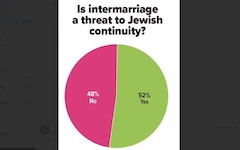 The Pittsburgh Jewish Chronicle
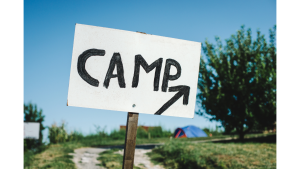 Noting that only about 22% of overnight campers come from interfaith families, 18Doors’ Adam Pollack says “That gap [with the high rate of interfaith marriage] tells us camps are not yet representative of the Jewish population today. We’re trying to find ways to make Jewish overnight camp accessible and appealing to families who already consider themselves part of the Jewish community but may not feel certain that camp is for them…. We know how transformative camp can be. We want all Jewish kids – including those from multi-heritage families – to have access to that experience.”
 The report says that the Working Group “commissioned thirteen informal position papers from historians, social scientists, and rabbis.” I was invited to make a