June 2026 News: Worth-watching CASJE panel; day school, federation and Reform silence; lessons from eminent rabbis; Milwaukee study

|

I don’t need to tell you that there is an awful lot going on in the world that demands attention.

In the Jewish world, most of the attention understandably continues to focus on Israel/Iran/Palestine/Gaza and on antisemitism.

I can’t help but feel that in the Jewish world, almost no one wants to talk about engaging interfaith families. It may be lack of bandwidth – but I think there’s more to it. And it’s especially problematic at this time, when uncertainty about the ongoing status of 18Doors demands, in my opinion, a concerted effort to engage interfaith families.

This month there was one bright development, a panel discussion devoted to interfaith marriage offered by CASJE and co-sponsored by eJewishPhilanthropy.

But elsewhere – in the day school world, the federation world, and the Reform world – silence and missed opportunity.

CASJE Panel

Thank you to CASJE, the highly-regarded Collaborative for Applied Studies in Jewish Education, for sponsoring “Jewish–Interfaith Families and the Future of Jewish Life in the United States” with eJewishPhilanthropy on June 11. The last time there was a publicly advertised webinar on this subject was a long time ago.

The 200 people who registered for the program heard from Bruce Phillips and Ted Sasson on recent demographic shifts: Phillips said people with one Jewish parent will outnumber people with two Jewish parents by 2 to 1; Sasson said a high rate of interfaith marriage and a high retention rate (those who identify as Jews) result in a growing population. Keren McGinity spoke about the tenacity of gendered behavior and the need to integrate equal parenting into programming. Rabbi Shena Jaffe explained how Honeymoon Israel is having its deepest impact on partners from different faith backgrounds and those with one Jewish parent. Sophie Mortman described what 18Doors has learned about what drives interfaith family engagement. I encourage you to watch the complete program here, and to see the slides here.

Mortman said that 18Doors hoped to pivot to building a field of professionals, offering training and support, and helping to connect across organizations. In my closing remarks about next steps, which you can view separately here, I encouraged support for that effort, and renewed my call for a concerted effort to engage interfaith families.

But other than the CASJE program, as Bruce Philips said, interfaith marriage seems to have “dropped off the communal radar.”

The Day School World

Prizmah: Center for Jewish Day Schools issued a report, which JTA headlined as “Jewish day school enrollment is rising across denominations.” The increased enrollment was measured in community and Reform day schools, among others. I’m all in favor of day schools for those who chose them. But unless I missed it, the report said nothing at all about interfaith families sending their children to day schools – whether that accounted for any of the increase, or whether efforts have been made to increase representation from that population.

The Federation World

Shortly after the Prizmah study came out, eJP reported “Israeli government, JFNA partner on $66.7 million plan to boost Jewish day schools.” Gary Torgow, Jewish Federations of North America board chair, told eJP, “In recent years, formal Jewish education has become a growing focus for JFNA…. Jewish identity and Jewish education are key to the future of the Jewish people and combating antisemitism.” Torgow said October 7 and antisemitism “awakened something in the Jewish community” about the importance of Jewish education.

But my review of national and local Jewish community studies found that only 22% of interfaith families (compared to 51% of inmarried families) provide any K-12 Jewish education for their children. JFNA hasn’t said anything about any effort to increase that participation.

Around the same time, JFNA released “2026 LGBTQ+ Jewish Engagement Report.” eJP headlined this study as “JFNA survey finds LGBTQ+ Jews want more than just a Pride Shabbat dinner.” It’s a very interesting report, with findings about what LGBTQ+ Jews are looking for and respond to that are applicable to interfaith families as well.

But the report is silent about interfaith identities and relationships. The Executive Summary begins by referring to the post October 7 surge in Jewish engagement among “historically marginalized Jews, including LGBTQ+ Jews, Jews of Color, Jews with disabilities, and financially vulnerable Jews.” When JFNA preliminarily reported on surge data among historically marginalized groups, at the May 2025 Jewish Belonging Summit, it included data on interfaith families. Now they’ve stopped talking about it, not even mentioning it in this report.

The survey instrument shows that JFNA asked about racial and ethnic identity, and the report does talk about issues that LGBTQ+ Jews who are also Jews of color face. But the survey didn’t even ask respondents if they were in interfaith relationships. Bruce Phillips’ analysis of the 2020 Pew data shows that 77% of gay or lesbian Jews, compared to 43% of straight Jews, are in interfaith relationships. Doesn’t that huge intersectionality merit study and comment?

The Reform World

In April I wrote about an eJP essay by a URJ leader that referred to the “multiplicity of diverse Jewish identities” but did not mention diverse faith backgrounds. I said, “The leaders of the Reform movement seem to think that interfaith family inclusion is at the center of its work because it was pioneered by the movement, and that they have been successful at it, so they don’t need to talk about or prioritize doing anything about it.” That was also the case at the May 2026 Re-CHARGING Reform conference, where interfaith family engagement was not on the agenda, as I previously reported.

Now the URJ is holding a biennial in December. In February I submitted a proposal for a program session to be called, “Interfaith Marriage – Where Do We Stand?” with potential speakers including someone from 18Doors, myself, and someone on the URJ staff. This month I was told that my proposed session would not be included. I did not get a specific answer to my follow-up question, “is one of the 65 sessions going to be about interfaith family inclusion? Even in part?” I was told, “Interfaith families are the norm in Reform communities and inclusion of interfaith families is both a topic worthy of its own time and also part of every other conversation. It is fair to say that many sessions will be relevant.”

I am very glad that many interfaith families find welcoming and inclusive Reform congregations. I personally benefited from the movement making that happen, as have so many others. But I can’t agree that the movement doesn’t need to talk about or prioritize doing more about it. As I said in April, “only 13% of interfaith families belong to synagogues. I wouldn’t be satisfied with that level of success.” I agree that “inclusion of interfaith families is … a topic worthy of its own time,” but that discussion apparently will not happen.

* * * * *

All of this leaves me feeling like interfaith family engagement is being erased from the communal discussion, like it doesn’t matter. Over twenty-five years ago when I started InterfaithFamily, I spent a great deal of time debating with Jewish leaders who condemned interfaith marriage. Their policy response was to seek to discourage or reduce interfaith marriage, and not support any programming aimed to engage interfaith families. As a result, over those years, the concerted effort that I believe was necessary did not happen.

Today, thankfully, almost no one outside of the Orthodox world is condemning interfaith marriage. But there’s so much silence about it. And the result of the silence is the same as the result of the condemnation: engaging interfaith families is not prioritized.

In fairness, parts of the community are promising. 18Doors’ Adam Pollack just posted on LinkedIn about a study it is doing with one camp, and other camp partnerships that involve training and helping camps build communities of belonging for mixed-heritage families. But so much more needs to be done.

Learning from Rabbi Matalon, and Rabbi Dreskin

Andy Silow-Carroll had a very interesting interview with Rabbi Rolando Matalon as he retired from Manhattan’s B’nai Jeshurun, “one of the most influential synagogues in American Jewish life.” The congregation decided in 2017 that its clergy could officiate at interfaith weddings despite doing so being forbidden by the Conservative movement’s Rabbinical Assembly, which Rabbi Matalon left in 2018.

Rabbi Matalon’s explanation why he decided to officiate is well worth reading. He then describes his conditions:

If a couple commits to building a Jewish home, raising Jewish children, converting children when necessary through mikveh [ritual immersion] at an early age, and participating in Jewish community, then we would officiate. We would not perform a kiddushin, traditional ceremony, exactly as it had been done, but a modified ceremony. The couple also had to commit to a serious process of learning and engagement with the rabbi over nine months to a year, and at some point explicitly affirm their commitment to a Jewish home and Jewish child-rearing.

Rabbi Matalon is pleased with the decision because it “broadcast that BJ is a welcoming community that wants to engage people rather than push them away. At the same time, we didn’t eliminate standards or expectations altogether. We said: If you’re interested, come and let’s engage seriously.” I have to wonder if this could not be a solution for the Conservative movement as it continues to struggle with this issue.

Coincidentally, I only recently saw this October 2024 piece in which Rabbi Billy Dreskin, a senior Reform rabbi, explains why he changed a position in 2022. Previously, he would not officiate for a Jew and a person who practiced another religion and intended to in their home. Now he will; his explanation is well worth reading. He concludes, “I love Judaism. And I want it to continue to exist. The world needs it to continue to exist. But in this time of schism and toxic dissent, I love love even more so. And while I will always celebrate when two Jews marry, I won’t ever again stand in the way of two human beings promising to love and care for each other forever. In fact, I will respond to their request for officiation with a wholehearted and grateful, ‘Yes!’”

Milwaukee Jewish Community Study

A reminder that interfaith marriage isn’t going away: the Milwaukee Jewish Federation released its 2024-2025 community study, conducted by the Cohen Center at Brandeis. Consistent with our analysis of 26 other local community studies conducted since 2013, people in interfaith relationships feel less of a sense of belonging to the Jewish people or their local Jewish community than inmarried people.

  • 42% of intermarrieds (compared to 74% of inmarrieds) feel very much a sense of belonging to the Jewish people (p 61); the respective averages of 26 other communities are 25% and 47%.
  • 13% of intermarrieds (compared to 35% of inmarrieds) feel very much a sense of belonging to the Jewish community where they live (p 61); the respective averages of 26 other communities are 6% and 26%.
  • 17% of intermarrieds (compared to 35% of inmarrieds) feel very emotionally attached to Israel (a traditional measure of belonging) (p 94); the respective averages of 26 other communities are 20% and 40%.

With respect to Jewish behaviors, 22% of intermarrieds, compared to 49% of inmarrieds, were current members of Jewish congregations (p 47). The study does not report the percentage of intermarrieds compared to inmarrieds who provide Jewish education for their children.

People who participated in programs or were interested in participating were asked about barriers to participation; interestingly, 17% of inmarrieds listed feeling unwelcome as a barrier, higher than the 7% of intermarrieds who did the same (p 70).

The open-ended comments in the study include (p 145):

Synagogues, while being inclusive, still maintain policies related to marrying couples who include both a Jewish and non-Jewish member that are hurtful and tend to push those couples away. This limits synagogue membership and alienates these folks from the greater Jewish community. – male, 75

When I got married, many years ago, my non-Jewish husband was not welcomed into my family’s synagogue. Things have changed, but I think if he had been, we might have raised my children more in the Jewish faith than his[Christian] church. – female, 56

The study conclusions and recommendations include (p 151): “Evidence from both the quantitative findings shared throughout this report and the qualitative findings shared in Chapter 12 revealed that many intermarried individuals and their families feel uncomfortable and unwelcome in Milwaukee Jewish organizations.”

With respect to research, I missed the Cohen Center’s study of Northeast Florida, and the Cohen Center has recently announced that a synthesis of data from all of their 30 local community studies is now available in their Benchmark Report; I’ll comment on these in a future newsletter.

May 2026 News from the Center: June 11 CASJE/eJP panel, Re-CHARGING Reform, Hartman on Belonging

|

CASJE/eJP Panel June 11

I’m pleased to be making remarks at a panel discussion on “Jewish–Interfaith Families and the Future of Jewish Life in the United States” hosted by CASJE and eJP, on Zoom on June 11, 12 to 1:30 pm ET. The panel follows publication of CASJE’s research digest on children of intermarriage and includes Keren McGinity, Ted Sasson, Bruce Phillips, Rabbi Shena Jaffee and Sophie Mortman. To register and for more information, visit https://www.casje.org/jewish-interfaith-families-panel.

Re-CHARGING Reform, Particularism and Universalism

The Re-CHARGING Reform Judaism conference happened again on May 27-28. The program schedule indicates that engaging interfaith families was not on the agenda – another missed opportunity.

A write-up in eJP about Rabbi Ammiel Hirsch’s keynote, which primarily addressed the Reform movement and Zionism, describes him as favoring Jewish particularism over universalism. The context wasn’t about interfaith families – but talk about particularism always makes me a little nervous. That’s because some see interfaith marriage as decreasing love for the Jewish people – rather than as potentially expanding it.

Hirsch’s talk elicited a strong response from Andrew Rehfeld, president of HUC, and that elicited a response from Jonathan Tobin. I was pleased that none of them blamed interfaith marriage for anything, in particular Tobin, who is no friend of interfaith marriage. I was more pleased that he was critical of “some within the Orthodox movement” who are “triumphalist” and indifferent about the liberal denominations, and who “write off the importance of the mass of non-Orthodox Jews as essentially irrelevant,” and of the “many in Israel” who “mimic this disdain.” I completely agree with Tobin that it would be a “catastrophe” if most of those who are affiliated with liberal denominations or who are unaffiliated were “lost to the Jewish collective.”

The Hartman Institute and Belonging

The biggest development this month was the Shalom Hartman Institute’s release of an important white paper, “Building Communities of Belonging: Jewish Identity, Conversion, Intermarriage and Adjacency,” written by Hartman fellow Christine Hayes.

Hartman is a preeminent Jewish leadership educational institution. So it’s noteworthy that it makes a series of positive statements about interfaith families and about interfaith family inclusion:

  • “While intermarriage has increased steadily over the past half-decade, its effect on personal Jewish identity, on the creation of Jewish families, and on organized Jewish life has not followed demographers’ predictions.” Intermarried Jews are raising Jewish children, and partners from different faith backgrounds often play a significant or sometime lead role in creating Jewish households. (pp. 21-22)
  • “[E]volving realities of Jewish identity, Jewish status, and communal belonging” prompt “many local Jewish communities and organizations to question whether they are actually as welcoming and inclusive as they want to be and to turn a critical eye toward their policies and practices around” intermarriage (and conversion and Jewish adjacency). (p. 2, 4) Some of those policies and practices “were not designed for their community or organization as it is currently constituted,” that is, with active involvement of people in interfaith relationships. (p. 22) Further, some policies and practices can “hinder belonging” (p. 2); some communities and organizations may be motivated by “a desire to grow … by developing policies and practices that extend Jewish status, or membership in good standing, to a larger number of interested individuals.” (p. 15)

The strength of the paper is its review of historical approaches to Jewish identity, status and standing. “While most community leaders are familiar with the general halakhah on these topics, they are often unaware of the way halakhah has played out in different historical circumstances over the centuries.” (p. 4) It reviews Jewish status based on patrilineal, double, and matrilineal descent (pp. 16-17), as well as Jewish status based on “the incorporation of foreigners” into the community or by religious conversion. (pp. 17-18) I learned a lot. For example, it’s confusing that  the term ger in the Torah refers to “stranger” or “resident alien,” but in later texts refers to converts; the paper explains very clearly how that linguistic change happened, and its serious implications.

The paper’s questions for discussion include, “How does an awareness of multiple approaches to intermarriage affect your community’s attitudes, aspirations, and options around intermarriage?” (p. 23) That is the key usefulness of the paper, and I recommend it highly. It certainly could be helpful, for communities and organizations that want to be welcoming and inclusive to interfaith families and partners from different faith backgrounds, to understand the historical approaches to intermarriage that are so clearly spelled out in the paper, that resulted in their current policies and practices, and that could be returned to, or turned away from, as new approaches are considered.

While the consideration of historical approaches is important, I believe that Jewish leaders and Jewish communities and organizations who want to be welcoming and inclusive also need to consider the attitudes they express about interfaith marriage and partners from different faith backgrounds, either in their statements or through their policies, and how those attitudes and policies can enhance or discourage feelings of belonging.

The paper does suggest good discussion questions that would surface those attitudes and what influences them: “does your community or organization view intermarriage as a problem or an opportunity?” “How has the presence (or absence) of intermarried people affected your community?” But the term “tribalism” does not appear in the paper. Social science data that some partners from different faith backgrounds feel “other,” like “outsiders” or “less desirable alternatives,” is not mentioned.

In the section devoted to people who are Jewish adjacent “without marital ties to the community,” the paper refers to “the fear that Jewish adjacency will dilute or negatively impact the character of Jewish communities persists.” (p. 29) The same fear persists with respect to the impact of interfaith marriage. That is a fundamental attitude that needs to be addressed. Some would say that in the more liberal denominations in the Jewish community, fundamental attitudes are the last remaining obstacle to inclusion, with the acceptance of interfaith marriage only a reluctant concession to social reality, instead of the affirmatively positive that is needed.

The paper expressly does not recommend any particular policies or practices, and recognizes “the legitimacy of multiple pathways and practices grounded in Jewish tradition.” (p. 2) As a result, it does not directly address the constraints that current understandings of halakhah with respect to matrilineal descent and rabbinic officiation at weddings of interfaith couples impose on Conservative-affiliated communities and organization who might want to change their policies and practices to be more inclusive. (Questions of status under halakhah loom large in a discussion of the white paper on the Canadian Jewish News’ “Not in Heaven” podcast.)

All in all, though, it’s very positive that the Hartman Institute wants to support communities and organizations that want to be welcoming and inclusive of interfaith families, and the white paper is a very helpful resource toward that end.

Israel

There’s not-good news from Israel on issues related to inclusion of interfaith families. Proposed legislation is pending that would change the Law of Return so as to allow citizenship only to converts according to Orthodox standards (criticized in the article by Rabbi Ammiel Hirsch) and to give control to Orthodox authorities over religious practices at the Western Wall. An influential Israeli writer and speaker also said that Jews who do not immigrate to Israel are “traitors” (criticized by Rabbi Josh Weinberg).

Canada

The Canadian Jewish News’ North Star podcast discussed “Canadian Jews trending toward more newcomers, intermarriage and aging.” Panelists said that of all households with marriages and at least one Jewish person, half are in-marriages and half are intermarriages; that there are “an increasing number of Jewish children who are living in mixed households;” that the federation “could have events for mixed families;” and that “day schools can think about how they want to cater to those families.”
In other news:

  • In “Reading a Pakistani author’s 30-year-old novel helped me understand my parents’ views on intermarriage,” a young Jewish woman who reads a novel about a Zoroastrian community in Pakistan. Unlike liberal Jewish communities, the Zoroastrian community excommunicates those who intermarry, which calls into question the usefulness of drawing any lessons about interfaith marriage from them.
  • An interesting article about a ledger kept by a Polish mohel from 1883 to 1920 recording circumcisions including of children of intermarried mothers who were not Jewish.
  • Jennifer Laszlo Mizrahi offers “Great TV: ‘Boston Blue’ & Its Shabbat Tradition,” reviewing a show about an interfaith, interracial family.
  • I’m not on Instagram, but a friend told me that influencer Amy Albertson, @theamyalbertson, posted “Here’s to all the non-Jewish moms raising Jewish kids. Thank you for opening your lives to a huge legacy, history and culture.”

March 2026 News: How Interested Are Jewish Leaders in Engaging Interfaith Families? Some Talk, and Research Support, But Little Action

|

I was busy this month with three presentations on what’s necessary for interfaith families and partners from different faith backgrounds to feel belonging in Jewish settings: with Cohort 5 of the 18Doors Rukin Fellows on March 10, with students and faculty at a lunch & learn at the Hebrew College Rabbinical School on March 17, and at an Academy for Jewish Religion/CA colloquium of students and alumni on March 30.

But I can’t say, based on this small sample, that Jewish leaders are becoming more interested in engaging interfaith families.

Talk

There is some discussion going on. There was an interesting commentary in the British Jewish press on the US Conservative movement’s recent report on intermarriage, which we’ve discussed at length in previous newsletters. I learned that the European branch of the movement, the International Rabbinical Assembly, is “studying the impact of intermarriage on our communities and assessing whether our traditional responses are achieving their goals or whether different approaches are necessary.”

At the Jewish Funders Network’s conference this month, according to eJP, “the theme of new voices in the philanthropic world was a topic,” and Jonah Platt talked about the opportunity to “start to create new institutions, or reprioritize our current ones in the way that they’re operating, and bring in all these other people who have not been engaged and want to be and don’t necessarily know how or what to do, but want to do it.” But if there was specific talk about engaging interfaith families, it wasn’t reported.

In early March there was an “unconference” in Miami to talk about the renewal of American Jewry. eJP reported that “Many issues already firmly in the Jewish communal zeitgeist came up repeatedly during panels,” including “the importance of better welcoming interfaith families.” An attendee confirmed to me that there appeared to be much interest in interfaith families. But shouldn’t representatives from organizations that work with and advocate for inclusion of interfaith families be included in gatherings of this type if the goal is real progress?

Research

I was pleased to see that the March 25 issue of the CASJE (Collaborative for Applied Studies in Jewish Education) Research Digest featured studies about interfaith families and their children, and that it mentioned our paper, What Recent Studies Reveal About Interfaith Family Inclusion.

The digest points to “a clear trajectory: in the years ahead, a growing share of Jews in the US will have only one Jewish parent;” that “more children of intermarried couples are identifying as Jewish because Jewish institutions became significantly more welcoming and inclusive toward intermarried families starting in the 1980s and 1990s;” and that “participation in Jewish educational opportunities can play a critical role in supporting children of intermarriage growing into adults who identify as Jewish and participate actively in Jewish life.”

These kinds of research results should support more programmatic efforts to be inclusive of interfaith families and to engage their children in Jewish educational activities. Whether they will – not clear.

Inaction/Action

Data in the appendix of a new study by the Cohen Center of 2025 Birthright Israel trips shows that the percentage of trip applicants who indicated that their parents were intermarried (those who did not say “all parents Jewish”) ranged between 33% and 37% between 2017 and 2020, reached a high of 41% in 2021, then declined to 32% in 2022, 29% in 2023, 24% in 2024, and a low of 19% in 2025. Given the trajectory of more Jews having one Jewish parent, it’s clear that Birthright needs to attract more applicants from that category, not fewer.

The study notes that the impact of trip participation appears to be greater among political liberals and on those who come from less engaged Jewish backgrounds, and states that attracting liberal Jews and those with less exposure to Jewish education is key to Birthright’s continued success. But it doesn’t say anything similar, that attracting children from interfaith families is key to Birthright’s continued success.

One concrete positive development this month was “Creating Belonging for Multiheritage Families,” an article by Michelle Barton and 18Doors’ Miriam Wajnberg in the journal of Prizmah, the network of Jewish day schools. The article relates the process by which the Shlenker School in Houston, with help from 18Doors, addressed the question parents raising children in interfaith families can ask: whether their family fully belongs.

“As family structures and Jewish journeys diversify, schools are called to examine whether their policies, cultures, language and rituals truly foster belonging or simply allow participation without full inclusion. Belonging is not synonymous with enrollment or participation. It reflects whether families feel seen, valued and confident that their full identities fit within the life of the school.”

The authors describe three obstacles that interfaith families face to belonging in Jewish communities and day schools: (1) an insider/outsider element; (2) a stigma against those who marry someone from another background; (3) “The belief in matrilineal descent creates barriers for multiheritage families to fully feel a sense of belonging in Jewish communities and schools.” “Even when a child from a multiheritage family may be fully accepted in one denomination or setting, that acceptance may not extend to all Jewish settings, resulting in ‘othering.’”

It is very heartening to see day schools focusing on interfaith family belonging. Almost twenty years ago, in 2007, for the tenth anniversary of the Partnership for Excellence in Jewish Education (which became part of Prizmah in 2016), I wrote “Interfaith Families and the Future of Jewish Day Schools.” I said:

“Schools can make themselves more accessible to these [intermarried] parents by making explicit statements of welcome, couching their specifically Jewish values in universal terms, and providing extra explanatory information on Jewish holidays, rituals and culture.” “Day schools could become laboratories that attempt to resolve the thorny issues of recognition. Every participant in a Jewish day school community could be considered – in some way – part of the Jewish community and people.”

It’s almost twenty years since I said, “Imagine how radically different the future of Jewish day schools would be if even ten percent of this growing population [of interfaith families] chose Jewish day schools.” We’re not even close to that yet – the recent Boston 2025 study found that 1% of children of interfaith families attended day schools compared to 23% of children of inmarried families. Efforts to foster belonging could lead to more enrollment. The many funders who support day schools might consider directing some of their funding to those efforts.

In other news 

I think Mira Fox was too dismissive of something in “Is Goy a Slur, an Antisemitic Dogwhistle or a Word for Non-Jews?” She says “goy” “simply means ‘non-Jew,’ or foreign nation which isn’t inherently insulting; Jews are far from the only group to have a term for outsider – think gringo in Spanish or farang in Thai. This can, of course, be exclusionary. There is certainly the sense that outsiders cannot understand or participate in certain activities of an in-group – an idea that is not limited to Jews. And sometimes that is used to discriminate or insult.”

I say that for people in interfaith relationships, any use of “goy” by Jews not just can be exclusionary, it is exclusionary and makes the partners from different faith backgrounds feel like outsiders. Even if the word has innocent meanings, I think any use of it by Jews is a bad idea.

Also noted:

February 2026 News: the 2025 Boston Study; A Message for Funders; How We Talk About Conversion; A Message for Rabbis; Honeymoon Israel Fosters Belonging

|

Boston 2025 CJP Survey

CJP released the 2025 Greater Boston Jewish Community Study on February 12. As readers of this newsletter know, I am most interested in what research reveals about interfaith families’ feelings of belonging in Jewish communities (see What Recent Studies Reveal About Interfaith Family Inclusion). That’s because for liberal Judaism to thrive, more interfaith families need to be more Jewishly engaged, and for people to engage, they need to feel belonging.

Most of the data relevant to interfaith families’ feelings of belonging is not reported in the thirteen individual reports that make up the Boston study. My understanding is that CJP is planning to make available a tool that will enable anyone to make inquiries about the data. So we need to be patient.

You can find what I have to say about the study in  Review and Analysis of the Interfaith Marriage Data in the 2025 Greater Boston Jewish Community Study. I will update the review when more data is available. In the meantime, some highlights:

  • The Boston Jewish community is heavily and increasingly intermarried – 50% of married/partnered Jewish adults are in interfaith relationships; of marriages since 2020, 58% were interfaith.
  • 69% of children in interfaith families are being raised Jewish in some way (the breakdown of Jewish only, Jewish and something else, etc. is not currently reported). Fewer children of interfaith families have Jewish education – 16% are in part-time K-8 programs compared to 61% of children of inmarried families.
  • CJP states that “interfaith households… are an integral part of the Greater Boston Jewish Community.” As mentioned above, data on how interfaith families feel about their connection to the Jewish community is not currently available, although it is for LGBTQIA+ Jews, Jews of color, Jews with disabilities, Russian-speaking Jews, Israeli Jews, and Jews of Sephardic or Mizrahi heritage.
  • There are indications in what’s been reported that interfaith families are less connected to the local Jewish community, which would be consistent with national and other local studies. The study says that “While most Jews in interfaith homes say they feel welcome, they are significantly less likely to participate in Jewish communal life.” The report says that those who feel connected and part of the local Jewish community are more Jewishly engaged. But only 22% of those who feel part of the local Jewish community are intermarried; 78% are inmarried.
  • There were follow-up interviews and focus groups with community members that gave “more insight on their feelings of inclusion and belonging.” But “most” of these community members “are avid synagogue participants who generally feel welcome in the spaces they choose to be in.” Apparently the insights do not reflect input from less engaged community members.

There is a lot of good news in the study. It’s great that a high percentage of children of interfaith families are being raised Jewish, but it’s worrisome that relatively few are getting Jewish education. It’s great that interfaith families generally feel welcome, but it’s worrisome that that doesn’t translate into feelings of connection that foster engagement. I hope a major part of CJP’s implementation efforts following the study will focus on fostering interfaith families’ feelings of belonging and providing Jewish education for their children. We look forward to what further data shows when it becomes available. 

A Message for Funders

The Jewish Funders Network International Conference is coming up. I’m not aware that interfaith family inclusion will be a topic of discussion. But there was a great essay by Jennifer Laszlo Mizrahi about how Jewish disability inclusion efforts grew that suggests what funders have the power to do. I’m replacing “disabilities” with “interfaith” in the following quote to illustrate what I hope they will do:

[A] small group of Jewish philanthropists and foundations began asking a simple but transformative question: What would it take for people [in interfaith relationships] to be fully included in Jewish life? A group of people active in Jewish philanthropy who had found that their families were not welcome in Jewish life due to [interfaith family inclusion] issues connected through the Jewish Funders Network. Together, they helped bring [interfaith family] inclusion into the philanthropic spotlight, and other philanthropists joined as allies.

Coincidentally, an essay about the JCC movement’s approach to disability inclusion expressed the importance of a comprehensive approach that is relevant to all inclusion efforts: “What we’ve learned is simple: inclusion is possible when shared, systematized and woven into the fabric of an entire movement. … With centralized leadership and shared language, frameworks and responsibility, we all can expand inclusion efforts and empower each other to join in this vitally important work.”

How We Talk About Conversion

Mijal Bitton wrote a beautiful essay about conversion. As I read it, though, I couldn’t help but think that it implied that partners from different faith backgrounds who do not convert remain outsiders. That is not an inclusive message that encourages interfaith families to be Jewishly engaged. How can we talk about conversion without doing that?

Bitton says that after the mikveh, “Someone who stood at the edge now stands inside;” that those “who bind their fate to the Jewish people by choice, are not meant to remain at the edges. They are meant to be received as insiders, with standing and responsibility.” She refers to the “rabbinic claim that converts are said to have been present at Sinai” and says that “to have stood at Sinai, whether by birth or by choice, is … to accept responsibility for a covenant that is still being made.”
But there are other textual claims that it was a mixed multitude that stood at Sinai, including the strangers in the camp, who can be understood to have accepted responsibility for a covenant to be Jewishly engaged.

This kind of messaging by Jewish leaders about the standing of partners from different faith backgrounds matters. I was struck by a comment in a very different context, a New York Times opinion piece about the conflict in Minneapolis, that expressed the importance of recognition by others:

“[W]ho we are is not just the idea we have of ourselves. It is also how others see us. The German philosopher Hegel elucidated this truth: The essence of our identity is not something we make on our own – it requires the recognition of others to be real. How we are perceived by others doesn’t just reflect who we are. It constitutes it.”

A Message for Rabbis

The CCAR convention is coming up. I’m not aware that interfaith family inclusion will be a topic of discussion. I urge Reform rabbis to read this very beautiful “Prayer for a Community of Belonging” by Rabbi Fred Greene. It sends the kind of inclusive message of recognition that we need to send. Do the partners from different faith backgrounds in your congregations feel noticed, named, known, needed and nurtured?

Honeymoon Israel Fosters Belonging

“‘It’s Complicated’ to Connected: Honeymoon Israel and Jewish Belonging Post 10/7” is a beautiful article by Honeymoon Israel staffer Emma Dunn. It describes how Honeymoon Israel fosters a sense of belonging among partners from different faith backgrounds. Dunn relates how Avraham Infeld speaks to trip participants about Jewish peoplehood as a shared sense of responsibility that “Jews by birth, Jews by choice, and partners who had come to Jewish life through love and relationship” (my emphasis) can develop. Infeld asks, “If you are choosing to build your life connected to the Jewish people, how will you show up for one another now and into the future?”

Dunn writes that “Honeymoon Israel offers a space where Jewish and mixed-heritage couples can explore their place in the Jewish people with honesty and care…. [C]ouples experience a broad and generous welcome into Jewish peoplehood. When they return home, they carry that sense of belonging with them and continue building Jewish life together.”

Left Out

There were several instances this month where the issue of engaging interfaith families could have been mentioned but wasn’t. Moment Magazine listed fifty Jewish innovators over the past fifty years; there was just one explicit reference to engaging interfaith families, a mention of Paul and Rachel Cowan’s 1989 book, Mixed Blessings. The Sapir journal published a conversation between Joshua Foer and William Foster on “What Makes a Moonshot?” and Charles Bronfman and Jeffrey Solomon offered “We Backed Birthright Israel. Now It’s Time for More Big Ideas for a Post-Oct. 7 World;” efforts to engage interfaith families weren’t mentioned as potential moonshots or big ideas.

Should the Jewish Press Survey Whether Intermarriage Is a Threat to Jewish Continuity?

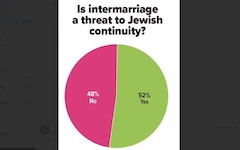
The Pittsburgh Jewish Chronicle polled its readers, asking “Is intermarriage a threat to Jewish continuity?” 52% said yes, 48% said no. Asking that question and publicizing that result sends a message to interfaith couples that their marriage is viewed negatively by many Jews, discouraging couples who might be potentially Jewishly involved.

The paper published some of the comments it received. Some were positive about interfaith marriages resulting in children being raised as Jews; some were negative – “Of course it’s a threat. You can pretend it’s not and do a bunch of interfaith stuff but it’s not authentic Jewish identity.” My favorite: “Intermarriage will continue regardless of the opinions of rabbis or families. Either the Jewish community finds a way to embrace these marriages or lose members of the community. One thing is certain, we lose if we don’t welcome them.”

In Other News

  • In the outright hostile to interfaith marriage department, an article on the Aish website says that the greatest threat facing the Jewish people isn’t antisemitism, it’s interfaith marriage (or the assimilation that is the result of interfaith marriage), and an ultra-Orthodox authority in Israel told followers not to go to the very wonderful ANU Museum of the Jewish People in Tel Aviv because, he says, it promotes interfaith marriage.
  • Israeli political parties are advancing legislation that would extend control over the entire Western Wall to the Orthodox rabbinate, which would result in Reform and Conservative Jews not being able to have prayer services there, and even criminalizing their egalitarian prayer at the Wall. (Forward, Times of Israel, JTA)
  • Jack and Quinn Hughes, whose parents are an interfaith couple, are featured in a JTA story as Jewish Team USA hockey stars; the very sad news about Savannah Guthrie’s mother generated a story about her interfaith marriage.
  • I happily stumbled on the website of Mosaic Law Congregation, a Conservative synagogue in Sacramento, that has a vibrating banner on its home page that reads “We Welcome Interfaith Families.”

January 2026 News: What’s Changed In Twenty-five Years; Important New Research; Making Jewish Camp Accessible; More Conservative News

|

How Times Have Changed

On January 11 I spoke at Congregation B’nai B’rith in Santa Barbara CA for the second time – the first was in December 2005. I took the opportunity to reflect on what’s changed about interfaith family inclusion over the past twenty years – and what work remains to be done. You can see the presentation on this video; the powerpoint slides are visible, and I’d be glad to share them.

One thing that’s changed is the fading away of the explicit hostility to interfaith marriage that was prevalent among Jewish leaders in 2005. In 2001, Sylvia Barack Fishman had done a study which concluded that interfaith families who say they are raising their children as Jews “incorporate Christian holiday festivities” into their lives such that Jewish identity is not transmitted to their children, even though they say that these festivities have no religious significance to them. I described this back then as “simply ridiculous,” based on surveys and an essay contest conducted by InterfaithFamily (now 18Doors).

After Fishman turned the study into a 2004 book, Double or Nothing?: Jewish Families and Mixed Marriage, I expressed fear that Jewish leaders would say that the “latest research” showed that “interfaith couples who were trying to raise their children as Jews shouldn’t bother because they won’t succeed,” and that “the Jewish community shouldn’t waste resources on outreach to mixed-married families, since the vast majority are not ‘really’ raising their children as Jews.”

I expressed hope that responsible Jewish leaders would insist on more conclusive social science research “before writing off the new families of the half of all young Jews who are intermarrying, thereby alienating their Jewish parents and relatives as well.”

I’m feeling vindicated all these years later. The Cohen Center at Brandeis just announced a new study which I think provides that more conclusive social science research. It notes:

Other work [citing Fishman’s 2004 book] has suggested that Jewish families who celebrate Christian holidays, or use Christian holiday decorations such as Christmas trees, struggle to instill Jewish identity in their children – even if these families do not treat these holiday activities as religious.

However, the results presented here suggest that at least some of the families who celebrate Christmas expose their children to more Jewish experiences than other families that had no Christian experiences at all…. [E]xposure to some non-Jewish religious-cultural experiences during childhood does not necessarily preclude high levels of involvement in Jewish life. (page 22)

The study (you can read a more detailed review here) even finds that children who celebrated Christmas and Easter (presumably in interfaith families) but were otherwise Jewishly involved “were more likely to have had a bar or bat mitzvah, to have attended Jewish supplementary school, and to have attended Jewish camp” than children who celebrated Hanukkah and Passover and had no other Jewish or Christian experiences (presumably these are inmarried families). (page 21)

Think of it – research confirms that some interfaith families are more Jewishly engaged than some inmarried families! Twenty years ago, we used to say that interfaith marriage didn’t determine the Jewish engagement of a family, the family’s choices did; we used to say that the Jewish partners in interfaith families couldn’t take their Jewish engagement for granted, they had to work harder at it. The new study seems to confirm that we were right.

Coincidentally, with all this looking back, in early January JTA published an article about the long-ago (1926) interfaith marriage of songwriter Irving Berlin that described issues around interfaith marriage as long-standing and continuing.

Even back then there were enlightened views. The editor of a Jewish newspaper actually said, “Mazel tov, Mr. and Mrs. Berlin!” Irving Berlin said, “It never struck me that I would be sacrificing a parcel of my Jewishness by marrying Ellin, and I suppose Ellin felt the same way about her religion. I am proud of my Jewishness, but you will never convince me that intermarriage is anti-anything.”

Jewish Camp

“For multifaith families, Jewish camp doesn’t have to feel awkward anymore” is a very promising report about the Foundation for Jewish Camp partnering with 18Doors to increase participation of children from interfaith families in overnight camp.

Noting that only about 22% of overnight campers come from interfaith families, 18Doors’ Adam Pollack says “That gap [with the high rate of interfaith marriage] tells us camps are not yet representative of the Jewish population today. We’re trying to find ways to make Jewish overnight camp accessible and appealing to families who already consider themselves part of the Jewish community but may not feel certain that camp is for them…. We know how transformative camp can be. We want all Jewish kids – including those from multi-heritage families – to have access to that experience.”
Conservative News

The main point of my Santa Barbara talk was that we still need to adapt attitudes and policies so as to help interfaith families and partners from different faith backgrounds feel that they belong in Jewish communities. The tension between including interfaith families and maintaining traditional understandings of Judaism as a boundaried system just for Jews continues to manifest in the ongoing turmoil in the Conservative movement.

As reported last month, the movement’s Joint Working Group issued a report with a goal to “engage intermarried couples more fully” but retaining the movement’s ban on their rabbis officiating at weddings of interfaith couples.

The report says that the Working Group “commissioned thirteen informal position papers from historians, social scientists, and rabbis.” I was invited to make a submission to the Working Group, and with their permission it is now public, on our new resource that chronicles related developments in the movement since 2014.
There was a lot of discussion about the report this month. 18Doors’ Adam Pollack offered a very interesting and positive response. I hope he’s right that “By ‘acknowledging and healing hurt,’ the movement has set a new course toward belonging” for interfaith couples. I hope 18Doors can help the movement in implementing the report’s recommendations. But I also hope the movement will address and change its position on officiation as I believe it must to truly be a place of belonging for interfaith families.

Conservative Rabbi Ari Yehuda Saks explained why, despite the movement easing its stance on interfaith marriage, he is quitting the Rabbinical Assembly:

I could not in good conscience remain a member while being prohibited from co-officiating intermarriages — ceremonies that I, from deep study and pastoral experience, have come to believe are not only possible within the halakhic, or Jewish legal, tradition, but are also vital for the future of American Judaism.

On the other end of the spectrum, Conservative Rabbi Amy Walk defended the movement’s approach. While pleased that the movement apologized for its past rejections of interfaith families, she says criticism of not allowing Conservative rabbis to officiate is short-sighted, binary, sloppy thinking.

Rabbi Walk said these critics “abandon ideas about commandment and covenant.” But the movement adapted halacha to allow women to be rabbis, and to allow wedding officiation for gay and lesbian couples – was that abandonment of commandment? And if the rationale for not officiating is Judaism’s traditional view that interfaith marriage is wrong, doesn’t maintaining the ban on officiating undermine the report’s efforts not to disapprove of and reject interfaith couples?

Even further out on the spectrum, Conservative Rabbi Daniel Gordis in a substack post says he was “stunned” at the Conservative movement’s apology; he “would argue that the policy against intermarriage has been a central pillar of maintaining Judaism’s tribal nature.” Gordis recognizes that defending the tribal dimension of Jewish life “has becoming increasingly difficult in a world in which young people, Jews definitely among them, find tribal sentiments either foreign, or outright objectionable.”

Gordis’ attitude is a prime example of what still needs to change. Thinking of Judaism as a tribe of Jews, instead of as a community of Jewishly-engaged people, is a huge obstacle to engaging interfaith families.

And finally, from the Orthodox perspective, Rabbi Emanuel Feldman says that by “’welcoming people as they are,’ the Conservative movement is declaring that they accept intermarriage.”

Also in the News

  • On January 27 the Jewish Grandparents Network hosted a virtual Grandparents Learning Fest that included a session led by Rabbi Samuel Klein, the director of Jewish engagement at the Jewish Federation of Greater Seattle, titled “Doing Jewish, Feeling Jewish, Being Jewish: Grandparents as Guides in Mixed-Heritage and Multifaith Families.” The session was to “share practical insights and provide inspiration for grandparents to nurture Jewish identity in diverse families.”
  • “Talking to Children About Jewish Identity in an Interfaith Family” is a new offering on the Reform Judaism website.
  • A lovely story in The Free Press, “I’m Christian. My Wife Is Jewish. Our Marriage Is an Act of Faith,” by a Catholic editor who says his marriage to a Jewish woman brought him closer to God. I loved this part:

One day when our children were small, I was playing with them in our living room. Our 3-year-old son was keen to put things in their proper categories. Attempting a slightly more advanced version of the ‘square pegs in square holes’ game, he observed, ‘I’m Jewish and Rachel is Jewish and Mommy is Jewish.’ His brow furrowed, and he looked at me with a compassion that still causes my heart to ache. ‘Don’t worry, Daddy; Toby is an Episcopalian.’ Toby was our dog at the time.

* * * * *

Congregation B’nai B’rith in Santa Barbara is a warm and thriving synagogue with a very popular monthly Sunday morning breakfast and speaker series. The audience of about 120 was very engaged, with questions during and after the presentation. Rabbi Daniel Brenner told me they had great feedback, with one person inspired to restart their interfaith family conversation series. I’m very interested in speaking elsewhere.

One last point about the Cohen Center’s new study shows that interventions can increase feelings of belonging: it found that for those who were Jewishly involved but celebrated Christmas and Easter, the percent that reported feeling “very much” part of a worldwide Jewish community after participating in a Birthright Israel trip increased from 27% to 37%. (page 19)

Finally, thank you to all who made a year-end contribution to the Center. Support is always welcomed, at www.cfrij.com/donate.

December 2025 News: Antisemitism and Interfaith Marriage; Conservative News; Views from Buchdahl, Sanderson and Kurtzer; December Holidays; Missed Opportunities; Pew Data

|

Addressing Antisemitism – a Personal Note, and the Importance of Inclusion

As usual in December, there’s a lot to report on about interfaith family inclusion. This year, it’s important to start with how that relates to antisemitism.

The month began with a report that Senator Cory Booker had married a Jewish woman. At the time, I commented on the Center’s Facebook page that I was glad to read that Booker’s friend Rabbi Matthew Gewirtz of Temple B’nai Jeshurun in Short Hills, New Jersey participated at the wedding, with Booker’s pastor.

Then there was a report that Booker lit Hanukkah candles for the first time at home – on the same day as the horrible antisemitic attack in Australia. He said, “My parents sort of told my brother and I about the ancient evil of antisemitism and the urgency to fight against it. But now that I’m married to a Jewish woman and we’ll – God willing, b’ezrat Hashem, have Jewish children, it’s taken on an even deeper, more personal sense of urgency.”

I’ve often felt that one positive by-product of interfaith marriage is that it can result in more allies of the Jewish people, and of Israel. I don’t just mean the partner from a different faith background – I mean all of their relatives, too. People who are not Jewish and might have no reason to think one way or another about Jews now, after their loved one is in an interfaith relationship, have a reason to be positive and supportive.

In that vein, I was very touched and moved this week when my son-in-law’s mother emailed me to say, “I have been struggling to find the words to let you know our abhorrence of the Australia attack. It is frightening what is happening, not just here but in the world, with the appearance of antisemitism.” My first thought was that it would not be irrational for her to regret that our mutual beloved grandsons are at risk of hate and even violence because they are Jewish. But that wasn’t her response. Her response was, “I can only have hope and do what I can.”

Our advocacy is motivated by the belief that we will have more people Jewishly engaged or supportive of their relatives’ Jewish engagement, the more we help make interfaith families, especially the partners from different faith backgrounds, feel a sense of belonging in Jewish communities. Addressing rising antisemitism is one reason why that advocacy is so important – something that Pulitzer Prize winning author David Shribman pointed out in “Welcoming the Intermarried: A Challenge and An Opportunity.”

Shribman writes that addressing the findings in our paper, What Recent Studies Reveal About Interfaith Family Inclusion, that “those in interfaith relationships don’t feel nearly as strong a connection to the Jewish people, or to their local Jewish communities, as those in relationships of two Jews” is “vital to the survival of Judaism in the United States, and to the preservation of Jewish values, especially at a time of rising antisemitism and divisions within the Jewish community over Israel and its response to” October 7.

Conservative News

It is fair to say that the Conservative movement is still struggling with how much of a sense of belonging it will foster among interfaith families and partners from different faith backgrounds. There is a lot that is positive in the movement’s just-released Joint Intermarriage Working Group Report. But the question of wedding officiation overshadows the progress.

The authors of the report “deeply apologize” for their historical stance disapproving of interfaith marriage. They “celebrate the meaningful contributions of Jewish-adjacent partners and spouses, and the children of such unions, in the work of creating and sustaining Conservative/Masorti Jewish households.” They want to “welcome, bless, and affirm intermarrying couples” (albeit only those “who are committed to solely Jewish practice.” They “recognize the delicate balance between ensuring that non-Jewish partners are aware of the option to convert while avoiding undue pressure.” They want to “ensure an appropriate path to formal affirmation for those who already identify as part of the Jewish people.” The “primary goal” of the process of finding a life partner is not endogamy, but “to empower the individual to articulate for themselves the kind of Jewish life they seek to lead. If they seek a partner, their goal would be to find a partner aligned with that vision of Jewish life.”

Much of this is quite remarkable coming from the movement. I hope all of their next efforts help them reach their goal to “engage intermarried couples more fully.”

But the elephant in the room remains whether and how Conservative rabbis will be allowed to participate in weddings of interfaith couples. Articles in eJP and JTA focus on the division in the movement over that issue.

It seems clear from the report that some members of the working group want the movement to allow more participation. The report itself talks about a “halakhah that recognizes that boundaries shift depending on circumstances and are not always a reason to say ‘no’; halakhah can also provide an opportunity to be inclusive and say ‘yes.’” They talk about having “ritual options to welcome, bless, and affirm couples with one Jewish partner and one partner who, while not formally Jewish, is firmly committed to co-creating an exclusively Jewish household. This includes opportunities to bless the couple, independent of the traditionally prescribed Jewish wedding ceremony, in the synagogue or elsewhere, before, on the day of, and after the wedding date.”

Ultimately, it’s going to be up to the Committee on Jewish Law and Standards, who the report asks to provide further clarification because “the standard of religious practice [which bans wedding participation] was created in part as a statement of disapproval of certain relationships and that we are shifting away from messages of disapproval.” The report asks the CJLS to “clarify whether other paradigms of marriage besides kiddushin that the CJLS has already developed and approved [presumably referring to gay and lesbian unions] might apply in the case of the union of a Jew with someone who is of another background.” In striking evidence of the split in the movement on this issue, the report notes that “Working group members asked that it be reported that there was not unanimity on this issue.”

Keren McGinity is quoted in the JTA article saying that fears of a “mass defection” if the movement were to allow its rabbis to officiate “have long been overstated.” She aptly pointed out that “avoiding change … also carries risks, pointing to the 2020 Pew study showing that fewer than half of Jews raised Conservative still identify with the movement. That is hugely concerning.”

Indeed it should be.

Three Thought Leaders with Important Statements

Rabbi Angela Buchdahl is on a tour this month speaking about her wonderful book, The Heart of a Stranger, which I have read and hope to write about in more detail later. I was struck by this comment in an interview in San Francisco:

“You can be a part of a family by just being born into it … and you can also become family through what’s called a covenantal relationship,” such as between spouses, Buchdahl said. “We don’t share any blood, but we made a covenantal promise, and that made us into a family. Every one of us who wants to be a part of the Jewish community [is] in a covenantal relationship with our people and with God. What if we were to imagine that everyone who wants to be a part of that covenant is 100% fully Jewish?”

This sounds an awful lot like what the Center has consistently advocated for: that everyone from a different faith background who wants to be part of the Jewish community should be thought of as and treated equally with their Jewish partner.

Jay Sanderson, president of American Jewish University, explicitly refers to the importance of including interfaith families in “The Jewish Future Is Calling.” AJU’s goal is “to reimagine and rebuild the foundation of Jewish life in North America.”

Sanderson says AJU “transformed Jewish learning when it launched the first intensive class for interfaith couples and individuals exploring conversion, helping countless people build Jewish homes and families.” They are now expanding to create “more welcoming pathways for anyone Jewish, Jew-ish and Jew-curious and nurturing the earliest steps of every Jewish journey.” They are offering in-person classes in multiple cities, to connect “interfaith couples and individuals learning about Judaism to each other so they can build peer groups that continue beyond the class.”

Sanderson says AJU is “building a Jewish future where Jews, no matter where they live or how they self-define, can find a place inside a reimagined Jewish community, one where every voice has value and everyone is contributing to the Jewish future.” This all sounds very promising, if a bit generalized; it’s not clear whether the voices of partners from different faith backgrounds would have equal voice and be allowed to contribute equally.

Yehuda Kurtzer, president of the Shalom Hartman Institute, wrote a brilliant essay, mostly about divisions between the Left and the Right over Israel: Our Fragile Tents: Community, Consent, and Care. One response to the 1990 National Jewish Population Study (with its finding of a high rate of interfaith marriage) was to “cultivate attachment through radically open approaches to welcoming people in.” This “found expression in the shift of liberal Jewish leaders who first tried to fight against intermarriage, then accepted it as inevitable, then welcomed interfaith families, and eventually worked to break down the barrier between Jews and the “Jewish-adjacent” among their stakeholders.”

“Opening the flaps of the Big Tent promised new possibilities for the Jewish community to expand and for all the moral gains that come with greater inclusion.”

Kurtzer laments that since October 7, “the primary emphasis of Jewish leaders has moved from widening the Big Tent to narrowing it, and from building Jewish community to trying to protect it.” “The kind of fear that has taken root in the Jewish community – of danger on the outside, of threats already on the inside – destroys any desire or incentive to think expansively about our networks of belonging.”

To reverse this trend, Kurtzer says “[W]e must be clearer about when and how we set boundaries in Jewish communities, so that our safety instincts do not harm our efforts to be welcoming more than they need to.” He says it is fair for institutions to cease partnering with other institutions over major values disagreements, but “it is a terrible side effect when individuals who affiliate with the rejected institution … are treated by members of the first institution as heretics.” Although he’s talking about divisions over Israel here, this made me think of how Orthodox leaders tend to be so disparaging of liberal Jews. They could maintain boundaries where halachic status matters (like marriage), while uniting with liberal Jews on other causes common to the larger Jewish community. Kurtzer doesn’t address this specifically; it would be interesting if he did.

Kurtzer makes an interesting observation about what belonging means, talking about being

“uplifted by an experience of communal singing and prayer, one that makes you feel connected to everyone in the room, or [experiencing] the warm hug of strangers caring for your needs in your own home while you are sitting shiva…. We have core anthropological, psychological, spiritual, and even biological needs for community in ways that are hard to define – though most of us can tell when a community ‘feels right’ and when it is time to move to a different one.”

It would be interesting to know what Kurtzer thinks is needed to cultivate those kinds of feelings of belonging in partners from different faith backgrounds.

December Holidays

Jessica Grose’s “What My Children Taught Me About Interfaith Tradition” is a very beautiful essay in her NY Times newsletter. She describes realizing that her family had “integrated” their interfaith household – she’s Jewish, she doesn’t identify her husband’s faith background, but it included Christmas: “On Sunday night, my family decorated our Christmas tree … Earlier in the day, my older daughter was practicing her Torah portion, and my younger daughter was working on a school slide show about the menorah we use every year …”

Looking back, she had wanted her children “to know what it meant to be Jewish, but … wanted to impart that in a way that didn’t feel oppressive or a rejection of my husband’s faith.” She hadn’t expected, as her children matured, that what she describes as “blending faiths” would become easier: “Our older daughter chose to start attending Hebrew school when she was 10, and has become part of a Jewish community that is welcoming to interfaith families. Her sister is eager to follow in her footsteps.” They also enjoy Christmas holiday rituals and traditions.

It’s interesting that she describes this as “blending faiths” – they clearly are very Jewishly engaged as a family. But she concludes with a key observation – that her daughters “don’t have to abandon any part of themselves for our family to feel whole.”

In a similar vein, in a nice article in the Boston Globe, Meredith Goldstein says, “There is no Christmas tree in the world that can erase who I am and the fact that I was raised by Ashkenazi Jews who studied music in New York City.” I liked this: “I believe that when people of different backgrounds get together and share a home, all of these traditions can and should coexist so everyone feels seen.”

Our friend Rabbi Melinda Mersack of Cleveland’s jHUB is featured in “Observing different holidays can be done, rabbis say,” emphasizing the importance of couples communicating what’s important to them about their holiday celebrations. Rabbi Matt Cohen is also featured, and I love what he says:

“In interfaith families, it’s important everyone feels equally a part of our community. We reach people through education, by teaching someone who is not Jewish, who is taking part in celebrating a holiday they haven’t celebrated in their upbringing, that they are just as much a part of our community.”

In other December holiday news:

Missed Opportunities

Two essays responding to the ATRA study on the rabbinate alluded to, but could have said more about, interfaith relationships. In “We have an opportunity to revamp liberal rabbinic education and Jewish lay leadership,” Rabbi Rebecca Sirbu notes that many contemporary Jews and their families “have non-Jewish members,” without saying more about the implications for rabbinic education. In “Rabbinical training doesn’t have a pipeline problem – we have a preparation problem, Rabbi Jesse Paikin says that “Genuine pluralism demands more porous boundaries than many legacy institutions prefer,” again without saying more about what those boundaries might be with respect to interfaith families.

Similarly, in an eJP interview about a new study by about disability inclusion, Matan’s terrific executive director Meredith Polsky says, “Disability spans every aspect of Jewish community life,” giving two examples: “If you work with individuals who identify as LGBTQ, there’s going to be people with disabilities. If you work with Jews who are multiracial, there’s going to be people with disabilities.” It’s unfortunate she didn’t include interfaith families among these other historically disadvantaged groups.

Pew Data

Some interesting new data from Pew considers why people keep their religion or leave. Jews are pretty high up (76%) in keeping their childhood faith (ranked third, after Hindus (82%) and Muslims (77%), but before those with no religion (73%), Protestants (70%), Catholics (57%), Latter-Day Saints (54%) and Buddhists (45%).

What struck me was how important a sense of community was as a reason why lifelong Jews remain are Jewish compared to other groups: Among U.S. adults who were raised Jewish and still identify as Jewish by religion, 57% cite liking the sense of community (compared to 38% of Catholics and 46% of Protestants).

Among those Jews, 60% say liking the traditions is an extremely or very important reason they are Jewish (compared to 46% of Catholics and 33% of Protestants); about half of Jews (53%) say they are Jewish because it’s their family religion (compared to 44% of Catholics and 30% of  Protestants).

In Other News

  • I thought it was extreme and unnecessary for Zohran Mamdani’s aide to have to resign because she made antisemitic posts on social media when she was 19 – given that now she’s married to a Jew and raising their children as Jews! This seemed like a pretty good case for  redemption to me.
  • Rabbi Barbara Aiello offers “The Challenges of Jewish Christian Grandparenting.”
  • A large synagogue’s executive director explains how he says “shalom y’all” to be inclusive.

Please Support the Center

We found spiritual support for our advocacy in an unusual place this month: the new bishop of the Church of Norway, whose focus is inclusion, not conversion; her calling has been to “swing open the doors … as wide as possible.”

We rarely ask for another kind of support – financial – but in the spirit of the season, with year-end rapidly approaching, we would be grateful for it. If you find our newsletter useful, if you value advocacy for inclusion of interfaith families – please make a contribution, in any amount, at www.cfrij.com/donate. Thank you!

November 2025 News: Laura Lauder and Embark; Rabbis and Interfaith Marriage in ATRA Study; Nobody Wants This; Chosenness

|

Laura Lauder and Embark

eJP ran an important interview of philanthropist Laura Lauder about the Embark program she launched and supports, now as part of Mem Global. The goal of Embark is “to have [non-Jewish partners] feel comfortable in their identity as a parent of Jewish children and as a member of a Jewish household. …[W]e are here to provide you with an educational experience with a cohort of other people in your same shoes, to enable you to decide for yourself, and whatever you decide, what we hope is that the decision is to make a warm, loving Jewish home and raise your children Jewish.”

The questions by eJP’s Jay Deitcher seem hostile to Lauder’s positions. He asks, “Do you ever fear that changing expectations of children related to interfaith relationships and intermarriage is a mistake? That the community’s leniency has gone too far….” He suggests that Embark does not strengthen Jewish community when he asks, “[S]tudies show that Jews who marry other Jews have stronger engagement with Judaism. Why not focus your effort on pushing for a stricter Judaism, or pushing for day schools or focusing your finances on strengthening the Jewish community?” Even the title given to the interview – “Still preferring Jewish marriages, Laura Lauder pledges $500K annually to boost interfaith couples” – is slanted; Lauder never says that she prefers “Jewish marriages.” The title also begs the question, with a 72% rate of interfaith marriage among non-Orthodox Jews, what is a Jewish marriage today?

Lauder’s position is laudable: “It’s not a conversion program…. [M]y sense is that we have to be inclusive and embrace these families who are interfaith and who want to raise their kids Jewish, so we want to provide a vehicle to enable them to do that.”

The Embark program includes a unit on Israel, about which Lauder says: “[W]e hope that these young people will keep their views on the issue on the Gaza war out of their decision as to how much they want to incorporate Judaism in their lives. I’m hoping that this particular Israeli government doesn’t dissuade them from wanting to have more Judaism in their lives.”

Rabbis and Interfaith Marriage

ATRA released a fascinating study conducted by Rosov Consulting about the rabbinate. Many of the study’s observations relate to interfaith families.

  • Congregations apparently want to be inclusive of interfaith families. In searching for rabbis, “inclusivity is a key characteristic of desired candidates. This inclusivity appears to be aimed at interfaith families … and those who are not halakhically Jewish but still seek to participate in community life. The postings include phrases [that reflect] a need for openness and acceptance. The candidate is characterized as a bridge between tradition and modernity, which requires a personality that is open and adaptable. This focus is clearest in positions aimed at fostering community with younger demographics (e.g., college students), but it is also present in many congregations seeking to remain relevant in a rapidly evolving society.”
  • More rabbis and future rabbis have interfaith backgrounds or relationships; among current rabbinical students, 20% were not raised Jewish or not raised exclusively Jewish. This creates issues for them.
  • Some students were “deterred by concerns, whether true now or not, that some aspect of their identity would disqualify them from being able to attend rabbinical school. Perceptions of how inclusive various rabbinical schools are for … students in interfaith marriages … shaped decisions about where to attend.”
  • “For some interviewees, coming from interfaith or non-Jewish backgrounds created feelings of exclusion and added hurdles in the admissions process. They described concerns that their backgrounds might be scrutinized more heavily, requiring them to prove their Jewish authenticity or justify their place in rabbinical training in ways that peers from more traditional backgrounds did not face.” One comment: “I have one non-Jewish parent, and that is a problem with a lot of people in the Jewish community, especially because it’s my mother. So, there’s plenty in the community who look at that and go, ‘you’re not really Jewish.'”

Nobody Wants This

Rabbi Lisa Rubin, who runs the very successful Center for Exploring Judaism program based at Central Synagogue, had an interesting take on the show, “Conversion isn’t a solo act. So why is the rabbi in ‘Nobody Wants This’ acting alone?” Rubin sees interfaith marriage as “an extraordinary opportunity for growth. Interfaith relationships, approached thoughtfully, can be pathways into Judaism rather than exits from it.” Her main point is that Rabbi Noah shouldn’t have tried to mentor Joanne himself, but rather should have connected her to a program – like the Center for Exploring Judaism – which she describes beautifully. She sees the show’s title as ironic, because “Jews should want this… [W]e should want our communities to see interfaith love not as a threat, but as a chance to expand the circle.”

For more on the Nobody Wants This front, it looks like there will be a season three, but the speculation is that Joanne will convert. I won’t get the show I was hoping to see, about a happily married, Jewishly-engaged, interfaith couple.

Chosenness

The Reconstructionist journal Evolve published an interesting essay by Rabbi Amichai Lau-Lavie about chosenness. At his congregation, Lab/Shul:

“[W]e have replaced the blessing at the Torah with asher bakhartanu im kol ha’amim – ‘Who has chosen us, along with all other peoples, to live this life with love.’ That is because I estimate that a good half of my community is not necessarily Jewish according to Jewish law. They are Jewish, they are Jewish-adjacent, they are people who have chosen to live with Jewish people. Some are Jewish patrilineally. Others, matrilineally. Still others, Jews by choice. We are human, and being Jewish is part of who we are.”

In Other News

  • An article from Religion News Service about how Vice President Vance hopes his Hindu wife converts to Christianity quotes our friend Susan Katz Miller, who aptly says, “To respect your partner and everything they bring to the marriage – every part of their identity – is integral to the kind of honesty that you need to have in a marriage.” And, “pressuring one’s spouse to convert or even hoping they would convert is not a good basis for a successful marriage.”
  • The Jewish Education Project’s otherwise excellent “What Will Jewish Education Look Like in 2050” does not mention any emphasis on reaching or including interfaith families.
  • I was not able to attend the JFNA’s General Assembly. I heard that there was discussion of engaging interfaith families, but have not seen anything published or public on that issue. An essay before the GA talked about “unveiling innovative platforms and programs that foster an inclusive culture and provide opportunities for deeper Jewish learning and involvement for those who may have been disconnected” before October 7. In an interview after the GA, JFNA’s CEO Eric Fingerhut said “There are great opportunities to increase the number of people engaged in Jewish life and education.” It remains to be seen how much priority will be given to engaging interfaith families.

April 2025 News: Steps Forward – Embark, Reinventing Hebrew School, What Belonging Requires; Obstacles – Bad Attitudes, Patrilineality, Officiation

|

There’s a lot to report this month: promising feelings of inclusion from a new program for interfaith couples; a great discussion of what’s involved in feeling belonging; new Hebrew school research that reflects that feeling unwelcoming is an obstacle; a Conservative rabbi advocates for officiation; a patrilineal teen’s determination to be recognized; the UK progressive movements are now both “equilineal”; negativity about interfaith marriage in an advice column question; a play with “shiksa” in a title song; and commentary on new demographic data about Montreal.

I’m looking forward to participating in the Jewish Belonging Summit sponsored by the Center for Jewish Belonging and SRE Network May 7-8 in Baltimore – especially discussions about advancing “belonging for all Jews and our loved ones.” It will be interesting to see how including interfaith families fits in with the larger agenda of affirming and celebrating the social and cultural diversity of Jewish life.

Inclusion: New Program, Research, Discussions and Omissions

Embark is a relatively new program, now part of Mem Global, for young adult interfaith couples. Rabbi Ari Perten of Mem Global and Ezra Kopelowitz, describing their program evaluation, say that Embark addresses the many interfaith couples who often experience “a sense of not fully belonging;” “rather than feeling like guests at Jewish events, [couples] gained the knowledge and confidence to lead rituals, host Shabbat dinners and engage meaningfully with Jewish learning on their own terms.” But “while Embark made them more comfortable in Jewish spaces generally, they still feel like outsiders in synagogue settings or other institutional Jewish environments.” The essay discusses steps to “help ensure that Embark participants feel not just welcomed but truly at home in Jewish life.” Embark seeks to create “a foundation for a more inclusive Jewish future – one where interfaith couples actively choose how they want to participate in Jewish community, rather than simply observing from its margins.”

New research about reinventing Hebrew school (the report, a summary of the report, and an eJP essay) notes the importance of inclusion. The research addresses the 70% of Jewish families who are underserved by Jewish education, “defined as those North American, non-orthodox, self-identifying Jewish and Jewish+ families who currently choose not to affiliate with traditional Jewish institutions or enroll in traditional supplemental Jewish education.” It doesn’t call out interfaith families, but does say “Often, Judaism is but one of multiple identities for these families,” and that some are “parents newly considering Judaism, but they don’t feel welcomed by Jewish institutions.” Traditional Jewish communities are perceived by some as “unwelcoming,” “judgmental,” “closed, insular,” “not always open to interfaith families.” The research makes an important call for an integrated family strategy, which I hope will include fostering feelings of belonging in interfaith families.

Rabbi Liz PG Hirsch, executive director of Women of Reform Judaism, talked about interfaith inclusion on her podcast with Rabbi Miriam Farber Wajnberg, director of professional development at 18Doors. It’s a very interesting discussion of what belonging means and requires, alluding to maintaining parameters as well as obstacles to inclusion.

Steven Windmueller missed an opportunity in “The third stage: An American Jewish revolution is upon us once more.” The first reason he gives for the need to “reinvent the Jewish brand” is that “we are not ‘growing Jews’; that is to say we need to increase our numbers, levels of engagement and our financial base. To do that requires a Jewish awakening that excites and energizes Jews to become involved.” I wish he had explicitly nodded to perhaps the greatest opportunity to increase our numbers: to excite, energize and engage more interfaith families – which requires including their partners from different faith backgrounds.

Obstacles to Inclusion: Attitudes, Patrilineality, and Officiation

Negative attitudes about interfaith marriage are still with us. Hey Alma’s advice columnist responded to a question from Jewish woman marrying a Jewish man who was worried that his two brothers would intermarry and forget Jewish traditions so that her own future children wouldn’t be able to celebrate Jewish holidays with future cousins. I loved Vanessa Pamela Friedman’s advice:
“I’m sure you didn’t mean to invalidate all interfaith families with your question, but it is really concerning to me that you’re making assumptions about how these Jewish men will continue to celebrate and honor their Judaism if they end up marrying non-Jewish women. You are experiencing anxiety over a hypothetical issue that may or may not come to fruition, but a lot of people in our community experience real anxiety over the very material judgements and marginalization they experience as patrilineal Jews. So I do find it very, very important to state upfront: Interfaith families who celebrate Judaism in meaningful ways are real, their Judaism is valid and it’s not up to you or anyone else to judge them.”

Related: there’s a song, “Shiksa Goddess,” in a 2001 musical The Last Five Years now playing on Broadway. I’ve always hated the word “shiksa” and agree completely that the song should be removed. I especially agree with the the Forward’s Rukhl Shaechter that “shiksa, even when used with positive intent, comes with demeaning cultural baggage.”

The Canadian Jewish News had an interesting discussion about Montreal’s relatively low but growing rate of interfaith marriage. In 2021 the rate was 22% compared to the Canadian average of 31%, but the number of Jews living in intermarried families grew by 29% in the preceding ten years. Comments by McGill sociologist Morton Weinfeld seem not particularly hospitable to interfaith families: he says research should look into “the quality of the life of those individuals where there’s been no conversion to Judaism, Chrismukkah families. The question often on the table now is to what extent is there space in modern Jewish life in Montreal for these mixed marriages… there are people clearly who will identify as Jewish, but their framework will be different from what it has been in the past. So how will other Jews in the community respond?”

In “I’m Half-Jewish But My Jewish Life Is As Full As It Gets” a patrilineal and very Jewishly-engaged teen gets told by a close family friend “you’re not actually Jewish” but concludes “while I may not fit others’ ideas of a Jewish teen born to Jewish parents, I will not let their comments affect my journey.” She quotes an essay from nine years ago by another patrilineal Jew who’s now a rabbi: “Being Jewish but not having a Jewish mother can be a symbol of a Judaism that is more desirable than a Jewish identity that insists on matrilineal Jewish inheritance or halachic conversion…. The Judaism I favor is a Judaism that is not built on being born into an ethnicity, but instead on choosing to live up to the Jewish covenant and choosing to belong to the Jewish people.”

In the UK, where the two progressive movements, Reform and Liberal, are creating a single Progressive Jewish movement, they call it “equilineality”: “Both movements now have an established route to equilineality, enabling children of one Jewish parent, irrespective of gender, to have recognised Jewish status. Both movements today are built by people of any sexuality. Both are fully egalitarian. Both have become fully able to integrate and build the Jewish lives of mixed faith couples and families.”

“Eight Years Later and We Are Still Lost” is an important contribution by Conservative Rabbi Steven Abraham. “We need to acknowledge openly that the current model – rejecting rabbinic officiation while encouraging outreach – is sending mixed signals that confuse and alienate more than they reassure.”

Also in the news:

A recent 18Doors email newsletter featured “See Me For Who I Am” by Stephanie Zulkoski who describes herself as “one half of an interfaith couple” who has “embraced Jewish traditions and culture.” She describes “small, negative experiences” that cause sadness and frustration and hopes people will become more open-minded and non-judgmental. Her advice: “please do not call me a shiksa”; “I am of a different faith background but would prefer not to be called a ‘non-Jew’”; and please don’t ask me “if I plan to convert.”

“Welcoming Baby” is beautiful advice from Rabbi Jen Gubitz for all Jewishly-engaged or potentially Jewishly-engaged couples.

The Cleveland Jewish News had a nice article with advice from Rabbi Melinda Mersack of jHub about seders for interfaith families (unfortunately termed “interfaith seder” by the reporter).

“My Husband and I Want To Host Passover But His Parents Won’t Let Us” has more good advice from Hey Alma’s Vanessa Pamela Friedman who questions whether part of the husband’s parents’ opposition is because his wife is not Jewish.

Ha’aretz has a story about a bad decision by an Israel ministry denying recognition of Reform and Conservative conversions done in Israel, disregarding a Supreme Court ruling.

We Open the Door for Elijah. Can We Open It for Seekers Too? is about fostering inclusion among those who are drawn to Judaism, but the descriptions are apt for interfaith couples too: “Sometimes the barrier … [is] [l]ingering doubts about who belongs.” “More people are seeking meaning—and many are finding their way toward Judaism. But they’re not always sure the door will open.” “I know what it feels like to be embraced – and what it feels like to be quietly be held at arm’s length.”

February 2025 News: New 18Doors CEO, One Rabbi’s Radically Inclusive Approach, Conservative Movement, Judaism Is About Love, New Research and more

|

A New CEO for 18Doors!

I was excited to see 18Doors’ announcement, picked up in the Atlanta Jewish Times, that Mike Wise, a very experienced Jewish professional, most recently co-founder of Honeymoon Israel, is their new CEO. I loved what Mike is quoted as saying:

With more than a 75 percent interfaith marriage rate among non-Orthodox Jews, it is critical for the Jewish community to welcome these couples who are Jewish and support them in building a Jewish home in whatever ways work for them. My work as founder and co-CEO of Honeymoon Israel is but one great example of the potential of deep engagement with couples coming from multiple faith backgrounds. Our deep commitment to working with and training rabbis is another critical piece of our work on behalf of the Jewish community.

I hope the organization will go from strength to strength under Mike’s leadership.

A Radically Inclusive Approach to Ritual Participation

Rabbi Fred Greene, who serves a Reform congregation in Boulder CO, wrote one of the best essays we’ve read in a long time – Everything Has Changed – In Synagogues, Too!

Rabbi Greene addresses one of the Center’s key advocacy positions, that partners from different faith backgrounds should be allowed – even encouraged – to fully participate in Jewish ritual:

I have shifted my positions to become much more expansive in how we officiate our life cycle events. In addition to officiating weddings where one partner might not be Jewish, we also include numerous opportunities for loving family members of bet mitzvah students to be included in aliyot.

When people can make informed and authentic choices, when those making Jewish choices in their households feel they can participate fully in ritual life without necessarily being Jewish (celebrating the ger toshav, the Biblical “sojourner” with the Israelites), they are not just thankful for the opportunity, they feel seen and needed. They, then, become more deeply grounded in our synagogue.

Amen!

Conservative Movement

The Conservative movement’s Intermarriage Working Group, that I’ve previously written about, send an email on February 10 seeking feedback. It’s an important message that’s worth reading.
The co-chairs of the Working Group, Shirley Davidoff and Rabbi Aaron Brusso, reiterate that past disapproval of interfaith marriage did not discourage it, but instead discouraged affiliation with Conservative synagogues. (All of the Working Group’s members are listed in the message.) They intend to “gather best practices, collect meaningful data, and commission innovative ideas to adapt halakhah, ritual, and ceremonies across the continuum of dating, engagement, marriage, and family life. Our goal is to shift from binary perspectives (“what is permitted vs. what is forbidden”) to a more holistic, nuanced, and pastoral approach to intermarrying couples.”

In furtherance of that effort, the email linked to a survey. Results should be interesting!

Judaism Is About Love – But What About Interfaith Love?

Rabbi Shai Held’s book, Judaism Is About Love, is a magisterial work of moral theology. I learned a great deal from it. When I first heard about the book, I was excited to see what it had to say about love between Jews and partners from different faith backgrounds. But there are only ten pages or so about romantic love between partners or spouses, and nothing directly about love between interfaith partners.
There are several interesting observations related to interfaith love, described in my review. Rabbi Held says “the assumption that we cannot control our emotions is a mistake”; people who disapprove of interfaith marriage, or who don’t support making any accommodations that might engage interfaith couples, sometimes justify their position by saying that the Jewish partner made a choice. Rabbis who officiate for gay and lesbian couples but not for interfaith couples, for example, sometimes justify the distinction by saying that being gay is not a choice.

Rabbi Held recognizes that how we view people can maim them: “A person or group of people can suffer real damage, real distortion, if the people or society around them mirror back to them a confining or demeaning or contemptible picture of themselves.” I couldn’t help thinking how this is applicable to partners from different faith backgrounds who are viewed as undesirable marriage partners for Jews.

Rabbi Held says that “any covenant theology will necessarily have both insiders and outsiders.  We can soften the edges around that fact but can’t sidestep it altogether. Covenants, like religions in general, like identities in general, are inherently particular; what matters from a moral perspective is not whether or not they have outsiders but how they imagine and interact with those outsiders.” I’m not sure what he means by “soften the edges,” but, as I have argued elsewhere, we could define the covenant as between God and not only people who are Jewish, but also people who do Jewish, who are Jewishly-engaged.

All in all, it’s a very important book, deserving of all the acclaim it is receiving, but I do wish more had been said about interfaith relationships. Perhaps that will be a future subject.

New Research

The Bay Area JCRC released a survey that is mostly about how safe Bay Area Jews feel after October 7. The J’s David Wilensky made an interesting comment in his weekly email newsletter:

47% of respondents are part of an interfaith family — almost half. 7% identify as people of color, and 19% live in a household that includes at least one person of color. I hear some congregations around here patting themselves on the back for being welcoming of interfaith families and people of color. Yet I also recently spoke with a Jewish friend whose spouse — a non-Jewish person of color who is helping to raise a Jewish kid — has been treated poorly at more than one large Bay Area synagogue. Again: If this survey is correct, almost half of Bay Area Jews are part of an interfaith family. Synagogues and other Jewish spaces simply cannot afford to dismiss them — or worse.

The Pew Research Center just released its Religious Landscape Survey – all 375+ pages of it. There’s a very good story about the survey by Judy Maltz in Ha’aretz. Her key takeaways include that Jews are more likely than members of other religious groups to say that religion is not too important or not at all important in their lives; that only one in three Jews reported that religion was very important to their family when they were growing up; and that among married Jews, 35 percent reported having non-Jewish spouses (compared to 25% of Catholics having non-Catholic spouses and 19% of Protestants having non-Protestant spouses). A separate section of the report, devoted to Religious Intermarriage, says that intermarried adults tend to be less religious than in-married adults.

The Jerusalem Post reported “exclusively” on February 9 about a new study of the impact of Birthright Israel. The Post’s story had a good headline: “Birthright Israel works: Alumni are more Jewishly active than their peers, study finds – exclusive.” Coverage of the Cohen Center’s past studies often touted that the trip led fewer participants to intermarry, which we always said contributed to negative attitudes about interfaith marriage and would deter children of interfaith families from participating. We always said that the goal of the trip should be to increase participants connections to Jewish life – regardless of who they marry. This story’s lead is that the trip instilled “long-term connections to Judaism and Jewish life for participants and their families, including for those who” intermarry.

The study does find that “Birthright participants were substantially more likely to have a Jewish spouse” – whether their first spouse (55% of participants compared to 37% of non-participants) or current spouse (63% compared to 46%). There’s nothing wrong with measuring or reporting on the rates in which trip participants in-marry. Suggesting that the goal of the trip is to reduce interfaith marriage is a bad strategy, that neither the study nor the JPost story do.

The study does not claim that Birthright participants and non-participants (those who applied for the trip but did not go on it) are representative of all Jews of the same age; the fact that the rates of in-marriage for both participants and non-participants are higher than the 2020 Pew report’s 28% of non-Orthodox Jews suggests that that is the case.

I thought two findings were especially interesting, because they address how couples are raising their children Jewishly, and differences between interfaith and in-married couples in that regard. 76% of trip participants with Jewish partners enrolled their children in early childhood programs, compared to 67% of participants with non-Jewish partners (I’m using the study’s “non-Jewish” terminology here); 47% of non-trip participants with Jewish partners did so, compared to 37% of non-trip participants with non-Jewish partners. 51% of trip participants with Jewish partners had a b’mitzvah ceremony for their children, compared to 26% of participants with non-Jewish partners; 33% of non-trip participants with Jewish partners did so, compared to 14% of non-trip participants with non-Jewish partners.

This data supports different conclusions. With respect to early childhood programs, there’s a difference, but not a big one (10% or less), between those with Jewish partners and those with non-Jewish partners. There’s a much bigger difference (25% and 19%) with respect to having a b’mitzvah, and one could say that almost half of trip participants with Jewish partners not having b’mitzvah ceremonies for their children is not a very satisfactory result. But to me the most important thing is to understand the reasons why interfaith couples choose not to raise their children Jewishly, and to address those reasons.

In Other News:

  • The Interfaithing podcast has a two part review of Nobody Wants This.
  • A JTA story about “swanky secular Shabbat parties” in New York City includes this:

Another aim of the new-school Shabbat dinners is to embrace the diversity of New York City’s Jewish community — and to welcome non-Jews to the table as well. “The main thing is to create the kehillah, the community,” Elad Zvit, the co-founder of Bar Lab, a hospitality company that operates the restaurant, previously said about Mesiba’s Shabbat dinner series. “We have a lot of diversity between our friends — some of them are Jewish, some of them are not. But the one thing we all have in common: We like to break bread together. We like to eat, we like to drink, we like to party together.”

  • You Should Know Rabbi Lizz Goldstein is a nice story in the Washington Jewish Week about a rabbi who grew up in an interfaith family.
  • A review in the Forward of a book about Finnish Jews in WWII is a good example of a casual comment that equates interfaith marriage and assimilation: “Assimilation and inter-marriage rates in Finland raise doubt about the community’s long term survival prospects. Author John Simon includes a sobering statistic in Strangers In A Strange Land: nearly every Jewish family in the country has a member who married outside the faith.”

January 2025 News: Jewish Families Today, Thinking Beyond Jewish Continuity, the Impact of October 7, and more

|

After all the December holiday media buzz, and with January attention focused on distressing events here and in Israel, there was little interfaith family inclusion news to report – until this week.

Jewish Families Today

This past Monday, eJewishPhilanthropy reported that Rosov Consulting released an important qualitative study, Jewish Families Today. The study focused on Jewish families with diverse backgrounds and identities, especially families not deeply involved in Jewish communities and institutions, with data generated from 40 focus groups and 40 individual interviews. It reports that parents want to build strong Jewish identities in their children, in homes that are also tolerant and inclusive of multiple heritages and faiths.

For the Center’s purposes, what’s most relevant are the “bumps, obstacles and difficult contexts” families face. In addition to cost, geographic distance, and political polarization, “Families with marginalized identities – whether interfaith, LGBTQ+, or multiracial – often feel sidelined within traditional Jewish institutions, encountering subtle or overt exclusion.”  Parents of children who have multiple identities “are especially aware that prejudice exists toward some, all, or simply the combination of these identities on the part of others, including in Jewish spaces.”

A key finding is that parents are “desperate” for community. They are not fleeing traditional institutions, but are looking for congregations that are inclusive of them. One parent said that the webpages of local synagogues did not have any kind of message explicitly addressed to interfaith families telling them who they could contact or what to expect. They are looking for “early signals of inclusion.” “Many families seek clear commitments to inclusivity that some institutions have been hesitant to extend.”

One interfaith couple had a lukewarm experience in Jewish institutions but were “actively engaged by their neighborhood Catholic church.” The study warns that “families who belong to more than one faith community may opt to participate in the non-Jewish one if it is more accessible and welcoming.” “Intentional, explicit practices of inclusion are essential if Jewish institutions are to attract families with marginalized identities.” “Families are “simply struggling to find communities … that “walk the walk” when it comes to including diverse families and where they know they will be welcomed and affirmed for their whole selves.”

I wish that the report had delved more into what underlies the prejudice or exclusion that some families experience. The Center’s theory is that interfaith families will engage Jewishly if the partners from different faith backgrounds are considered and treated as equal; they experience prejudice or exclusion when they are considered as lesser and their participation is restricted. It’s not clear from the report whether the study participants experienced this or not.

One of the study’s key recommendations is to “shift culture to become a more inclusive and welcoming community,” noting that “Even when synagogues and organizations attempt to welcome Jewish families with intersectional identities, challenges can exist in the interpersonal interactions within the community.” The Center believes that adapting how Jews think about and treat partners from different faith backgrounds is essential to any shift in culture towards inclusion.

Thinking Beyond Jewish Continuity

Then this past Tuesday, eJewishPhilanthropy published Rabbi Shmuly Yanklowitz’ “Thinking Beyond ‘Jewish Continuity.’” It’s very worth reading; I agree with Rabbi Shmuly’s call to go beyond defensive fear and be aspirational about fostering robust Jewish community, to “go deep” and to “feed souls.”

In describing the conversation we need to go beyond, he says “Jews are assimilating. Younger Jews are intermarrying,…” There’s a hint there of equating intermarrying with assimilating, but I’m pretty sure that’s not the way Rabbi Shmuly thinks. I do wish that he had explicitly included appealing to interfaith couples and partners from different faith backgrounds when describing his five ideas for cultivating a shift.

The Impact of October 7 on Interfaith Couples, Families and Professionals

18Doors has released an excellent resource with research and discussion questions for couples, grandparents, and professionals. “It behooves the Jewish community to lean into loving relationships when they exist. We need to welcome anyone and everyone who wants to be Jewish, anyone who is throwing their lot in with the Jews or is related to a Jewish person. These people can be among our greatest strengths.”

In Other News

“Relationship advice: Your duty to the Jewish people matters more than what makes you happy” is an awful piece in the Jerusalem Post by Rav Hayim Leiter, an Orthodox rabbi in Israel, who says “our priorities need to be building and raising healthy Jewish families, and there’s no way to do that when marrying out.”

A year ago, Rav Leiter responded to a mother, who felt strongly after October 7 that her children and her family are Jewish, writing that her children aren’t Jewish because Judaism is “transmitted through the maternal line.” As I said in our February 2024 newsletter, that was cruel, insensitive, “false as to much of the Jewish world outside Rav Leiter’s Orthodox lane, and counter-productive to anyone who wants to see the number of Jewishly-engaged people expand.”

It’s unfortunate that those like Rav Leiter can’t respect that there is more than one way to be Jewish, or see the benefit to the Jewish people overall of including interfaith families. It’s unfortunate that their hostile views continue to be expressed.

Cantor Rabbi Mark Goldman, who serves a Reform synagogue in Florida, wrote two interesting but curious posts in the Times of Israel blogs. In the first, he questions whether the approach he has taken to interfaith couples, conditioning wedding officiation on their committing to raising a Jewish family and taking an introduction to Judaism course, is productive, or instead leads couples to not work with him. That’s a very good question.

But in the second, he writes that “without structured opportunities to continue engaging in Jewish life, many [young adult Jews] drift away, making intermarriage more likely… If young Jews lack community during this stage, their likelihood of marrying outside the faith increases significantly.” He urges expansion of opportunities for young adult Jews to have “appealing, contemporary experiences [to] make Judaism feel accessible and relevant.” It’s ill-advised to make the goal of engagement opportunities to make interfaith marriage less likely. Why not be explicitly clear that the opportunities are for young adult Jews who are in interfaith relationships too, with the goal of interfaith couples experiencing Judaism as accessible and relevant?

The Wall Street Journal published “Jewish Identity in Crisis” (at page 35), a review of books including If You Will It  by Elliot Abrams. I haven’t read the book yet; the reviewer says that peoplehood is the book’s “key word” and quotes Abrams as saying ““The underlying problem is that a striking proportion of American Jews have very weak feelings about being part of the Jewish people in anyway at all.” In the past, Abrams was no friend of interfaith marriage; it’s interesting and hopeful that the review at least doesn’t reflect any blaming of interfaith marriage for weakening feelings of peoplehood. Moreover, to strengthen peoplehood, it’s all the more important to be inclusive of interfaith families.

In a similar vein, eJewishPhilanthropy reported that a group of 40 Israeli leaders convened to discuss Jewish cultural (as opposed to religious) identity. It is interesting and hopeful that they spoke of those who married “outside the tribe” in a non-judgmental way:

True, these young Jewish adults are often not observant and do not belong to traditional or institutional Jewish frameworks, which may seem “too religious” or irrelevant to their Jewish identity and life choices (particularly for LGBTQ and those who marry “outside the tribe”). Nevertheless, their Jewish identity is present and meaningful in their lives. They describe taking pride in their Jewish identity, celebrating holidays, feeling a sense of tribalism and connecting to Judaism through family and pluralistic values. Additionally, as we’ve seen over the past year, they are not indifferent to Israel. Focusing on what they are and using positive terms rather than “un-” to describe them is the first cornerstone of creating a more meaningful Jewish cultural identity.

“How Jewish Identity Is Formed Matters” is a very interesting op-ed that’s not directly about interfaith marriage. The author, Rabbi Yehudah Potok, is the senior director of the Jewish Education Program at Facing History and Ourselves. One comment that struck me: “when a person finds security and comfort in one’s own identity, they generally do not feel as threatened by the identity of others. Developing a strong sense of self promotes empathy and inclusivity.” That made me wonder whether, if we were more secure and comfortable in our Jewish identity, we’d be more inclusive of and not threatened by interfaith marriage and partners from different faith backgrounds.

Finally, in an interesting sign of the times, the Conservative movement in the UK is offering a discussion course for mixed-faith couples. The course is “designed to help couples think about what a mixed-faith relationship means, and a brief introduction to Jewish life and practice.” The course “isn’t about conversion, although conversion may be something that couples are thinking about.” It notes that “Masorti rabbis do not officiate at mixed-faith ceremonies, although mixed-faith couples are welcome to join Masorti synagogues.”